In this guide
- What Does Finding a Cat for Mating Involve?
- Should You Breed Your Cat?
- Which Health Tests Come Before Mating a Cat?
- How Does Cat Breeding Actually Work?
- How to Breed a Cat in 7 Steps
- Where to Find a Cat for Mating
- Stud Service Fees and the Mating Agreement
- What to Check by Breed
- Frequently Asked Questions
- The Bottom Line
Your queen has the coat, the temperament and the pedigree you love, and you would like to see her line continue. The next question is the hard one: where do you find the right partner, and what has to happen before the two cats meet?
Finding a cat for mating is less about luck and more about preparation. Responsible cat breeding means proving both cats are healthy, checking that their blood types are compatible, matching their registration, and agreeing every term with the other owner before a single mating takes place.
This guide covers the full picture for first-time breeders: the health tests that matter, how a queen's cycle works, the steps to arrange a mating, how to judge a stud cat owner, and what goes into a fair agreement. If you also breed dogs, Petsfindly's dog breeding guide covers the canine side.
Key takeaways
Maturity first
Veterinary guidance suggests queens be at least 12 to 15 months old before a first breeding.
Test both cats
FeLV and FIV tests plus blood typing should come before any introduction.
Mating triggers ovulation
Cats are induced ovulators, so plan several matings over two to three days.
Put it in writing
Settle the fee, repeat matings and registration paperwork before she travels.
What Does Finding a Cat for Mating Involve?
The words breeders use, and who does what
In cat breeding, the female is called a queen and the intact male is called a tom. A tom kept for breeding with other owners' queens is a stud cat, and the arrangement is known as stud service. In most cases the queen's owner looks for the stud, pays the agreed fee or offers a kitten, and raises the litter. The stud owner provides a healthy, tested male and a safe place for the cats to meet.
Successful cats breeding is a two-owner job. Arranging mating for cats works best when both owners think of it as a partnership. The queen's owner wants proof that the tom is healthy and well bred. The stud owner wants the same proof about the queen, because an unhealthy visitor can bring infection into a cattery and damage the reputation of every cat in it.
Should You Breed Your Cat?
Age, registration and honest motives come first
Deciding to breed a cat is a commitment that lasts well beyond the mating. You will be responsible for the pregnancy, the birth, weeks of kitten care and finding every kitten a good home. Before you search for a partner, it helps to answer a few honest questions about your cat and your plans.
Is she old enough?
Queens can come into heat well before their first birthday, but early heat does not mean she is ready. A veterinary review of normal feline reproduction advises waiting until a queen is at least 12 to 15 months old before her first breeding. The same review notes that fertility starts to decline around three and a half to four years and suggests retiring queens around six. Petsfindly applies a similar cautious age window to cat breeding matches, which it explains in why breeding windows are strict on purpose.
Is she registered, and is that the plan?
If you want registered kittens, both parents need to qualify with the same registry. The two largest in the US are The International Cat Association (TICA) and The Cat Fanciers' Association (CFA), and each has its own rules for litters. Keep her registration certificate and pedigree papers together before you contact any stud owner, because a serious one will ask for them in the first conversation.
Do you have time and a plan for the kittens?
Owners who have been breeding cats for years will tell you to have homes in mind before kittens arrive, to budget for vet care in case anything goes wrong at the birth, and to be ready to keep kittens with their mother until they are old enough to leave. If any of that feels uncertain, it is fine to wait a season.
Which Health Tests Come Before Mating a Cat?
Screen both cats before they ever meet
Before mating a cat, the Merck Veterinary Manual recommends a veterinary check of her general health, genetic background and reproductive status, along with testing for feline leukemia virus (FeLV) and feline immunodeficiency virus (FIV). Ask the stud owner for the same results on the tom. Breed clubs and your vet can tell you which genetic tests matter for your breed.
Health checks to complete before a mating
Test or check | What it looks for | Who needs it |
|---|---|---|
Veterinary exam | General health, body condition and reproductive soundness | Both cats, every time. Routine blood and urine tests are often advised for older queens |
FeLV and FIV tests | Two retroviruses that cause lifelong infection | Both cats, shortly before mating |
Blood typing | Type A, B or AB blood | Both cats, especially in breeds where type B is common |
Vaccines and deworming | Up-to-date protection before pregnancy | The queen, ideally two to three weeks before breeding |
HCM DNA test | Known heart disease mutations in some breeds | Ragdolls, Maine Coons and related breeds |
PKD1 test or ultrasound | Inherited kidney cysts | Persians and breeds with Persian ancestry |
FeLV matters to both owners because, as Cornell's Feline Health Center explains, an infected mother can pass the virus to her kittens before birth or through nursing. FIV spreads mainly through bite wounds, and Cornell notes that mating itself is not a significant route. Testing both cats still protects everyone in both homes.
Your vet will also want the queen in good body condition and current on routine care. The 2022 review in the Journal of Feline Medicine and Surgery recommends updating vaccines and deworming two to three weeks before breeding and avoiding vaccination during breeding and pregnancy.
How Does Cat Breeding Actually Work?
Heat cycles, induced ovulation and pregnancy
People search how does cat breed or how to mating cats when what they really want is the biology behind a successful pairing. Three facts explain most of it.
Queens cycle with the seasons
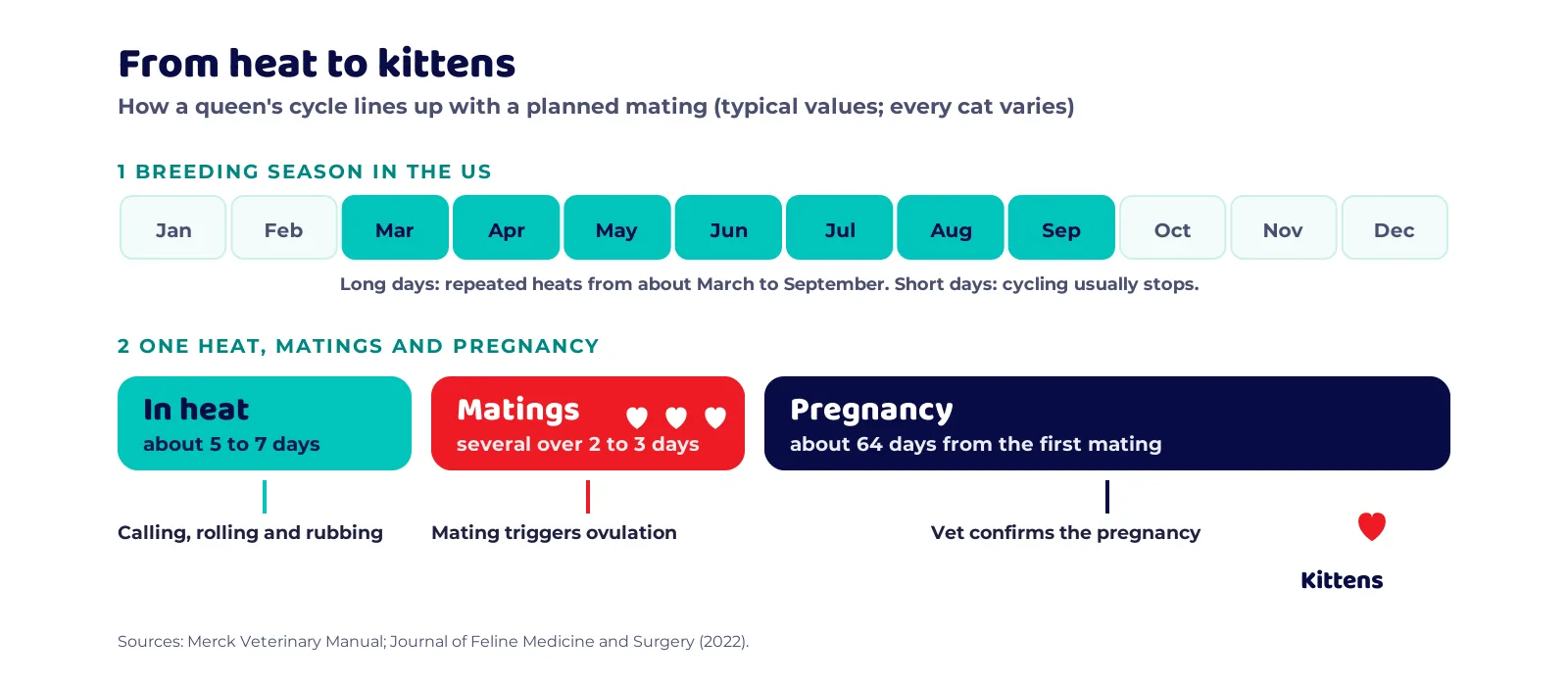
Queens are seasonally polyestrous, which means they come into heat again and again while days are long and stop when days are short. In the US that season usually runs from about March to September, although indoor lighting and latitude change the pattern. Each heat typically lasts five to seven days, and the signs are hard to miss: loud calling, rolling, rubbing and raising her hindquarters when stroked.
Mating triggers ovulation
Cats are induced ovulators, so the act of mating is what triggers the release of eggs. One mating may not be enough. The Merck Veterinary Manual recommends breeding on several occasions over about two to three days, and suggests separating the cats between matings to prevent exhaustion and fighting.
Pregnancy lasts about nine weeks
Gestation averages about 64 days from the first mating, with a normal range on either side. Your vet can confirm pregnancy and, later on, estimate how many kittens to expect.
How to Breed a Cat in 7 Steps
From the first vet visit to a confirmed pregnancy
If you have been asking how do you breed a cat responsibly, this is the order experienced breeders follow. Most problems start when owners skip ahead to the mating, so take the steps in sequence.
1Book a pre-breeding vet exam
Start with a full checkup for your queen. Ask your vet about her weight, any past health problems, and whether her breed calls for heart, kidney or eye screening before she is bred.
2Complete her health testing
Run the FeLV and FIV tests, confirm her blood type and finish any breed-specific DNA tests. Keep the official lab reports, because a careful stud owner will ask to see them.
3Gather her paperwork
Put her registration certificate, pedigree papers and microchip number in one folder. If you plan to register the litter, read your registry's litter rules now rather than after the kittens arrive.
4Find a compatible stud cat
Look for a tom of the same breed, a compatible blood type and complete health results. The section on finding a partner below covers where to look and what a good profile should show.
5Agree the terms in writing
Settle the fee or kitten arrangement, how many matings are included, what happens if she does not conceive and who signs the litter paperwork. Then both owners sign.
6Arrange the visit when she comes into heat
Many stud owners prefer the queen to come to them, since a tom usually feels most confident on his own territory. Bring her once her heat begins, follow the stud owner's quarantine and introduction routine, and allow two to three days for several matings.
7Confirm the pregnancy with your vet
Once she is home, watch for her heat to end and book a vet visit to confirm the pregnancy. That appointment is also the time to plan her nutrition and a quiet nesting area. Knowing how to breed your cat well means staying involved long after the mating.
Where to Find a Cat for Mating
Search where serious owners list their cats
The best cat for mating is rarely the closest one. It is the tom whose breed, bloodline, blood type and health results suit your queen, owned by someone who screens visitors as carefully as you screen him. Owners usually find that partner in three places.
Your breeder and breed club
If your queen came from a breeder, start there. Breeders know which lines pair well with theirs, and many keep their own stud cats or know someone who does. Breed clubs and cat shows connected to TICA and CFA are also good places to meet owners who take testing seriously.
A matching platform built for breeding partners
Petsfindly lets you browse cats listed for breeding by breed and distance, and see the health results each owner chooses to share before you send a message. Every member is phone-verified, browsing is free, and Petsfindly never handles payments between owners. You can create a free listing for your queen or start a match search and see why each suggested partner fits.
What to check on a stud cat profile
Check | What good looks like |
|---|---|
Breed and registration | Same breed as your queen, registered with your registry, pedigree papers available |
FeLV and FIV status | Recent negative results the owner is happy to show |
Blood type | Compatible with your queen, especially if she is type B |
Genetic tests | Results for the conditions known in his breed, such as HCM or PKD1 |
Proven or unproven | Whether he has sired healthy litters before, and how many |
Temperament | Calm, social and confident with people and other cats |
Owner's rules | Clear terms, a quarantine routine and a written agreement |
Many of the questions a careful female owner asks a stud owner are the same whether the pets are cats or dogs. Petsfindly's questions to ask a stud owner before breeding is a useful starting list to adapt.
Stud Service Fees and the Mating Agreement
Fair terms keep both owners on good terms
There is no official price list for stud service. Fees vary widely by breed, bloodline, show titles, completeness of health testing and whether the tom is proven, so the only reliable way to judge a fee is to compare similar studs and ask what is included.
Common stud service fee structures
Structure | How it works | Watch out for |
|---|---|---|
Flat fee | A set amount, often split between the visit and a confirmed pregnancy | What happens if she does not conceive |
Kitten in place of a fee | The stud owner takes a kitten from the litter instead of cash | Pick order, sex and what happens with a very small litter |
Fee plus kitten | A reduced fee plus a kitten | Every detail needs to be in writing |
Repeat mating | A free return visit on her next heat if she does not conceive | Time limits and who pays for travel |
Registration is part of the agreement too. With CFA, the queen's owner starts the litter registration, and if you do not own the sire, CFA emails the stud owner and the litter stays pending until they respond. TICA treats the queen's owner at the time of mating as the breeder and allows a litter by a sire it has not registered when you supply a certified three-generation pedigree. Write down who completes which step.
Mating agreement checklist
Clause | What to cover |
|---|---|
Owners and cats | Names and contact details for both owners, plus both cats' registered names and numbers |
Health requirements | Which tests each cat needs and how recent the results must be |
Fee and payment | The amount, kitten terms or both, and when payment is due |
Stay and care | How long the queen stays, what she eats and who pays her vet costs |
No pregnancy | Whether a repeat mating is included and for how long |
Registration | Who submits the litter paperwork and when the stud owner signs or confirms |
Right to refuse | Either owner can cancel if a cat seems unwell on the day |
What to Check by Breed
Popular breeds, specific priorities
Persian and Exotic Shorthair
Polycystic kidney disease is the first question for Persian lines. The UC Davis Veterinary Genetics Laboratory explains that PKD1 is inherited in a dominant pattern, so a cat with one copy is affected and each kitten has a one in two chance of inheriting it. Ask for a DNA result or an ultrasound screening. Exotic Shorthairs share Persian ancestry and also carry type B blood more often, so blood typing is just as important.
Maine Coon
Maine Coon owners focus on heart health. A DNA test is available for the A31P mutation linked to hypertrophic cardiomyopathy (HCM) in the breed. That test covers one known mutation only, so ask your vet whether heart screening by a veterinary cardiologist also makes sense for a breeding cat.
Ragdoll
Ragdolls have their own HCM mutation, R820W. According to the UC Davis Ragdoll HCM test page, cats with two copies face a high risk of severe heart disease and should not be bred, and pairing two single-copy cats is expected to produce about a quarter high-risk kittens. Check both cats' results before you agree a match.
British Shorthair, Cornish Rex and Devon Rex
These breeds have a high frequency of type B blood, which makes blood typing essential before any pairing. British Shorthairs with Persian ancestry may also be screened for PKD1.
Frequently Asked Questions
Quick answers to common cat breeding questions
How do you breed cats for the first time?
Most first-time owners asking how do you breed cats start with a vet exam, FeLV and FIV tests and blood typing for the queen, then find a tested stud cat through their breeder, a breed club or a matching platform, and sign a written agreement before the visit.
How old should a cat be before breeding?
Veterinary guidance suggests queens be at least 12 to 15 months old before a first breeding. Toms should be mature, healthy and fully tested before they are offered for stud.
How many times do cats need to mate?
Because cats are induced ovulators, one mating may not trigger ovulation. Breeding on several occasions over about two to three days is the usual recommendation.
Can I breed my cat with any tom?
If you want to know how to breed my cat responsibly, choose a tom of the same breed with a compatible blood type, matching registration and complete health results. A random neighborhood tom carries real infection and blood type risks.
How long are cats pregnant?
Gestation averages about 64 days from the first mating, although a range on either side is normal. Your vet can confirm the pregnancy a few weeks after mating.
Does the queen go to the stud cat or the other way around?
Usually the queen travels to the stud cat's home, because toms tend to be more confident on their own territory. Agree the length of her stay and her care in the written agreement.
The Bottom Line
Preparation makes the best pairings
Learning how to breed a cat well comes down to patience and proof. Wait until your queen is mature, test her and any partner for infection and blood type, check the genetic risks in your breed, and put every term in writing. Most guides on how to breed cats stop at the mating itself, but the owners who do best are the ones who chose the right partner in the first place.
When you are ready to look for a cat for mating, search where owners share their cats' health results openly, ask every question that matters, and walk away from any pairing that does not feel right. Your queen and her kittens are worth that care.
Ready when she is
Find a partner for your queen
List your cat for free and see breeding partners by breed and distance, with the health results their owners choose to share. Your phone number stays private until you decide to share it.
- Free to browse
- Phone-verified owners
- We never take payments
Further reading
- Merck Veterinary Manual: Management of reproduction of cats
- Journal of Feline Medicine and Surgery: Normal feline reproduction, the queen (2022)
- Cornell Feline Health Center: Feline leukemia virus
- Cornell Feline Health Center: Feline immunodeficiency virus
- UC Davis Veterinary Genetics Laboratory: AB blood group in domestic cat breeds
- UC Davis Veterinary Genetics Laboratory: HCM in Ragdolls
- UC Davis Veterinary Genetics Laboratory: Polycystic kidney disease (PKD1)
- The Cat Fanciers' Association: Steps to register a litter online
- The International Cat Association: Frequently asked questions
This guide is general information for cat owners and is not veterinary or legal advice. Talk to your veterinarian before making any breeding or health decision, and check your local laws on breeding and selling animals.