In this guide
- What Does It Really Take to Breed Dogs?
- When Is a Dog Old Enough to Breed?
- Which Health Clearances Does a Breeding Dog Need?
- How Do You Find the Right Mate for Your Dog?
- How to Breed a Dog in 8 Steps
- What Happens During the Heat Cycle and Pregnancy?
- How Do You Register Puppies and Find Good Homes?
- Breed Spotlights: What Changes From Breed to Breed?
- Dog Breeding FAQs
- The Bottom Line
Most people who search how to breed dogs start by asking about the mating itself. Experienced breeders start about a year earlier, with a plan on paper.
Breeding is one of the most rewarding things a dog lover can do, and one of the most demanding. A healthy litter begins long before two dogs meet: with health clearances, a carefully chosen partner, a written agreement and a list of families ready to give puppies a home. Skip any of those and the risk lands on the mother, the puppies and the breed.
This beginner's guide covers all about dog breeding in the order you will need it: deciding whether to breed your dog, the age and health rules, finding a partner, the heat cycle and pregnancy, and what happens after the puppies arrive. Every health and registration fact links to its source so you can check it with your vet. For the bigger picture of how matching works, start at Petsfindly's dog breeding hub.
Key takeaways
Mature first
Wait until about two years old, when OFA can issue final hip and elbow ratings.
Test before you match
Breed health clearances and a brucellosis test protect both dogs and every puppy.
Plan the homes
Line up screened families before the mating, not after the puppies are born.
Write it down
A stud contract settles fees, puppies, repeat matings and registration upfront.
What Does It Really Take to Breed Dogs?
Two dogs, two owners and a lot of responsibility
Dog breeding is the planned mating of a female, called the dam, with a male, called the sire or stud, to produce puppies with predictable health, temperament and type. When people ask how do you breed dogs, the honest answer is that the mating takes minutes, the preparation takes months and the responsibility lasts for the life of every puppy.
Good pet breeding has one goal: puppies that are healthier and steadier than the average for their breed. That is why breed clubs encourage members to breed only dogs that are sound examples of the breed standard, fully health tested and calm in temperament. Looks alone are never a reason to breed.
The work is also shared unevenly. If you own the female, you carry the pregnancy, the birth and at least eight weeks of puppy care. If you own the male, you answer for what he passes on. The table below shows how the jobs usually split.
Who does what in a typical breeding
Task | Dam (female) owner | Sire (stud) owner |
|---|---|---|
Health clearances | Completes them for the female before breeding | Keeps the male's results current and shares them |
Brucellosis test | Before every breeding | At least once a year, as the AKC advises |
Timing the mating | Tracks the heat cycle and progesterone with the vet | Keeps the male available during her fertile window |
Pregnancy and whelping | Full responsibility | None, beyond any support agreed in the contract |
Puppy registration | Submits the litter application | Signs to confirm the mating took place |
Finding homes | Screens families and places every puppy | Takes a puppy only if the contract says so |
Many owners type breed my dog into a search bar because friends keep admiring their pet. Admiration is a lovely start, but it is not a breeding plan. Use the quick check below to see where you stand today.
Interactive check
Are you ready to breed?
Tick everything that is true right now. Nothing is saved or sent anywhere.
Let's see where you stand
Tick the boxes to get your next step.
See the 8 stepsWhen Is a Dog Old Enough to Breed?
Fertile is not the same as ready
Dogs can be fertile surprisingly young. The AKC's guide to the reproductive cycle notes that a female's first heat usually arrives between 6 and 18 months of age, and she can become pregnant on that first cycle. That does not make it wise. Most responsible breeders wait until a breeding dog is about two years old, and there is a firm reason: the Orthopedic Foundation for Animals (OFA) only issues final hip and elbow ratings once a dog is at least 24 months old. Earlier X-rays get a preliminary result only.
Registration rules set the outer limits. The AKC litter registration glossary states that a dam must be at least 8 months and no more than 12 years old on the date of mating, and a sire at least 7 months and no more than 12 years. Treat those as legal minimums, not targets.
Breeding age at a glance
Milestone | Female (dam) | Male (sire) |
|---|---|---|
First fertility | First heat, usually 6 to 18 months | Often before his first birthday |
AKC minimum at mating | 8 months | 7 months |
AKC maximum at mating | 12 years | 12 years |
Final OFA hip and elbow ratings | From 24 months | From 24 months |
Typical responsible start | Around 2 years, after clearances | Around 2 years, after clearances |
Timing also depends on the female's cycle. Most females come into heat every 6 to 12 months, and a few breeds, such as the Basenji, cycle only once a year. Petsfindly takes the same cautious view in its matching, and explains it in why breeding windows are strict on purpose.
Which Health Clearances Does a Breeding Dog Need?
Test the parents so the puppies never pay the price
Health clearances are results from independent experts showing that a dog is free of, or unlikely to pass on, the inherited problems common in its breed. They are the best tool a beginner has, and serious owners of dogs for breeding expect to see them before any talk of dates or fees.
Each breed's parent club works with the OFA's Canine Health Information Center (CHIC) to choose the tests that matter most for that breed. A dog that completes its breed's list, with the results made public, receives a CHIC number. Start with the CHIC list for your breed, then confirm the details with your veterinarian.
Common health clearances for breeding dogs
Screening | What it checks | Who usually needs it |
|---|---|---|
Hip evaluation (OFA or PennHIP) | Hip dysplasia and overall hip structure | Medium and large breeds |
Elbow evaluation | Elbow dysplasia | Medium and large breeds |
Eye exam | Inherited eye disease, checked by a board-certified veterinary ophthalmologist | Most breeds, often repeated yearly |
Cardiac evaluation | Inherited heart conditions | Many breeds, including Golden Retrievers |
Patella evaluation | Kneecaps that slip out of place | Toy and small breeds |
Breed DNA tests | Known mutations, such as degenerative myelopathy | Breeds with DNA-testable conditions |
Brucellosis test | A contagious infection that causes infertility and pregnancy loss | Every dog, before every breeding |
DNA results deserve a careful read. Many inherited conditions are recessive, which means a dog can carry one copy of a gene and show no signs at all. Two carriers bred together can produce affected puppies, while a carrier paired with a clear partner cannot produce puppies affected by that condition. A mentor or your vet can help you read the results and plan around them.
How Do You Find the Right Mate for Your Dog?
Choose on evidence, not on looks
Choosing a partner, or a mate dog, is where many first litters go wrong. Experienced breeders pick their dog breeding dogs by comparing evidence: health clearances, temperament, how closely each dog fits the breed standard and how well the two pedigrees complement each other. A stunning dog with no results is not a match. A plainer dog with full clearances and a steady temperament often is.
Look for a partner who balances your dog's weaker points instead of doubling them. Check that the pedigrees are not closely related, ask about any previous litters and meet the dog if you can. Petsfindly's guide to the questions to ask a stud dog owner before breeding gives you a full list to work through, and the dog mate finder lets you filter dogs for breeding by breed, distance and shared health results. If you own a female, the stud my dog page gathers stud listings in one place.
Once both owners agree, put every term in a written stud contract before anyone travels. Verbal deals are where most disagreements between owners begin.
What a stud contract should cover
Term | What to agree in writing |
|---|---|
Fee and payment | A cash fee, pick of the litter or both, and when each is due |
Health proof | Which clearances and how recent a negative brucellosis test each owner will show |
Number of matings | How many breedings are included within one heat cycle |
Return breeding | Whether a repeat mating is offered if no puppies result, and on what conditions |
Puppy terms | Which puppy the stud owner takes, when they choose and what happens with a small litter |
Registration | Who signs the litter application and any limits on the puppies' registration |
Travel and care | Who pays to transport the female and who looks after her during the visit |
How to Breed a Dog in 8 Steps
From a written plan to puppies in new homes
Whether you searched how to dog breeding or how do I breed my dog, this is the order responsible breeders follow. Each step depends on the one before it, so resist the urge to jump ahead to the mating.
1Write a breeding plan
A breeding plan answers four questions in writing: why you want this litter, what you hope to improve, who will take the puppies and what you will do if something goes wrong. It is the quickest way to spot a weak idea before a dog pays for it.
2Join a breed club and find a mentor
Your breed's national parent club and its regional clubs connect you with experienced breeders, health clinics and puppy referrals. A mentor can assess your dog honestly and talk you through your first whelping.
3Complete the health clearances
Book the screenings on your breed's CHIC list and give yourself time. Some results take weeks to return, and final hip and elbow ratings need the dog to be at least two years old.
4Choose a mate and sign the contract
Compare clearances, temperament and pedigrees, meet the other owner and sign a stud contract before anyone travels.
5Time the heat cycle
The female sets the date, not the calendar. Your vet can run progesterone blood tests during her heat to estimate ovulation, which the AKC explains is used both to time the breeding and to predict the due date.
6Manage the mating
Mating can be natural or done by artificial insemination with your vet. Keep both dogs calm, supervise closely and never force an unwilling female. AKC online litter registration only covers natural matings, so litters from artificial insemination follow a separate AKC process.
7Prepare for pregnancy and whelping
Plan vet checks, adjust her diet on your vet's advice and set up a whelping box in a warm, quiet room well before the due date. Agree an emergency plan with your vet, including who to call at night.
8Register the litter and find homes
Submit the litter registration, start puppy vet care and match each puppy with a screened family. This is where the work of finding homes, started months earlier, pays off.
What Happens During the Heat Cycle and Pregnancy?
Know the stages so you can spot problems early
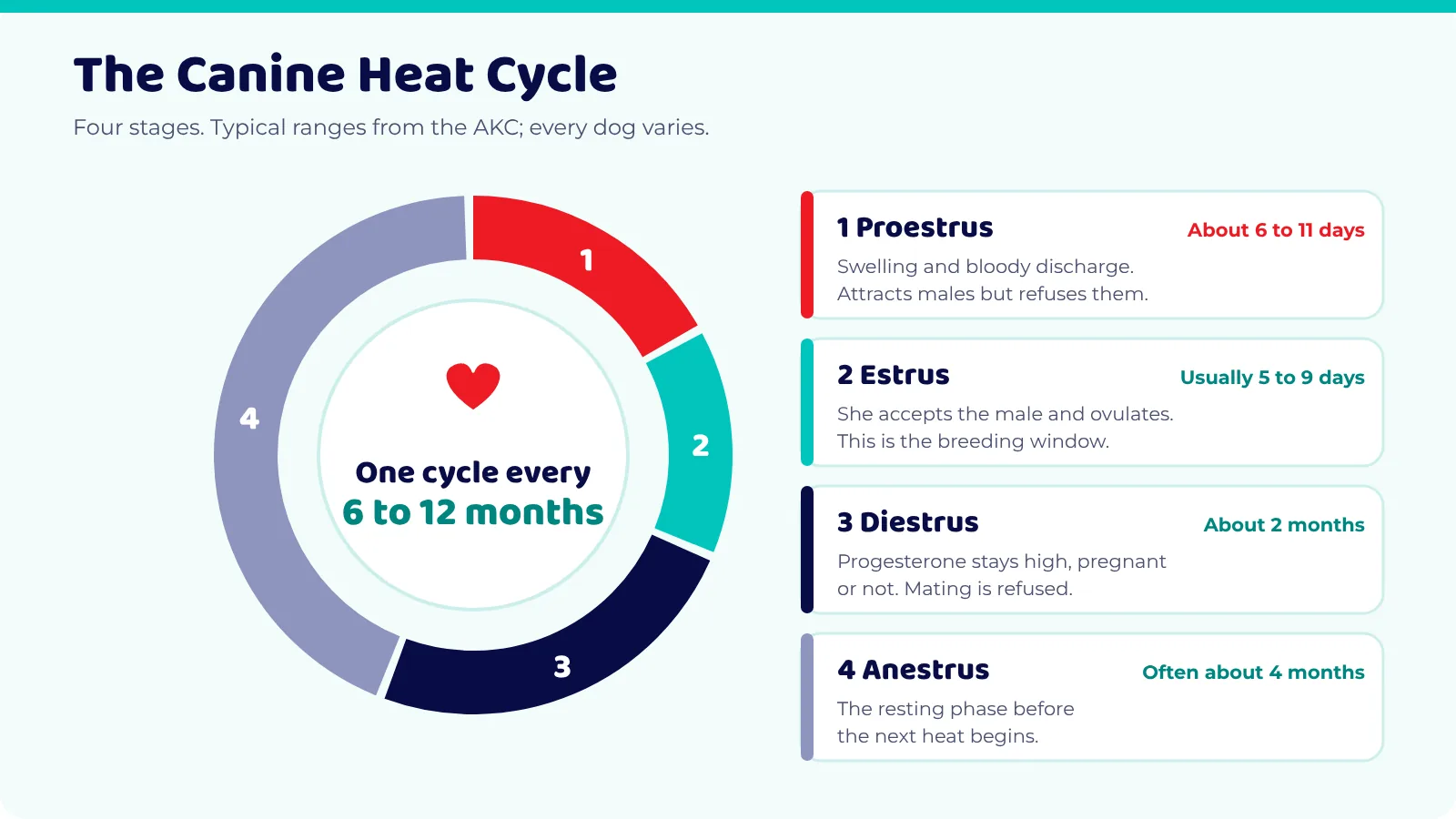
A female's heat cycle has four stages. In proestrus, which usually lasts about 6 to 11 days, she attracts males but refuses them. Estrus follows, typically 5 to 9 days, when she accepts the male and ovulates. Diestrus comes next, with progesterone staying high whether or not she is pregnant, and anestrus is the resting phase before the next heat. These ranges come from the AKC's guide to the canine reproductive cycle, and individual dogs vary.
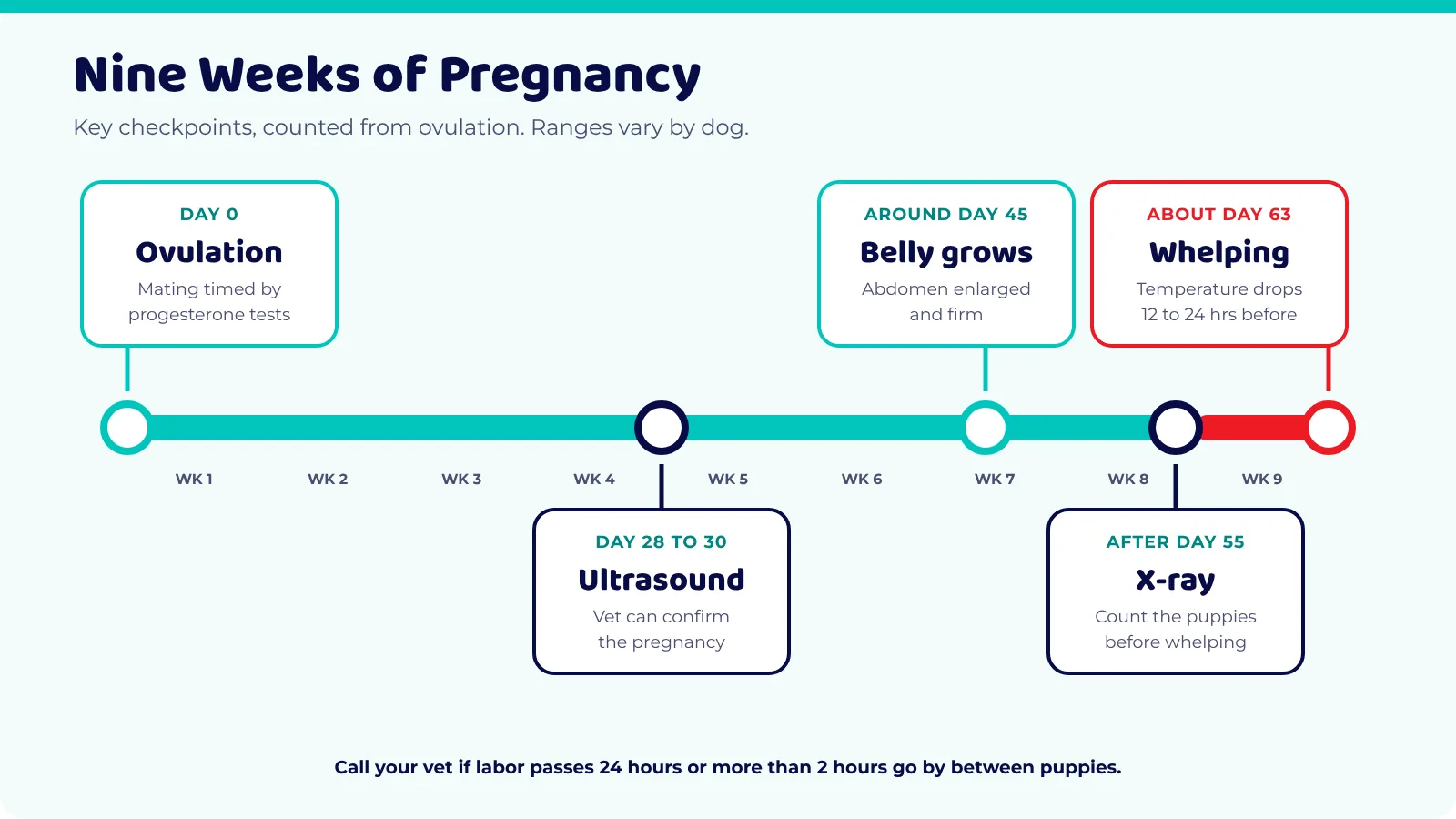
Pregnancy lasts about 63 days from ovulation. According to the AKC's pregnancy guide, a vet may confirm it by ultrasound around day 28 to 30, and an X-ray after about day 55 lets you count the puppies so you know when whelping is finished. Her body temperature usually drops 12 to 24 hours before labor begins.
How Do You Register Puppies and Find Good Homes?
The puppies arrive and the real responsibility begins
For AKC breeds, the owner of the dam submits the litter registration, and the AKC requires it to be signed by all owners of the dam and one owner of the sire. Once the litter is registered, each puppy can then be registered individually. Many breeders choose limited registration for pet puppies, which means none of that dog's offspring can be AKC registered, and only the breeder can lift it.
Puppies need vet checks, vaccinations and deworming on a schedule your veterinarian sets, plus time with their mother and littermates. The Animal Legal and Historical Center at Michigan State University tracks state laws on this, and about half of US states set a minimum age before a puppy can be sold or transferred, most often eight weeks.
Finding homes is the part beginners underestimate most. Start a waitlist before the mating, interview families about their routines and experience, and promise in writing that any puppy can come back to you at any point in its life. Petsfindly connects owners around breeding, adoption and rehoming, but it is not a marketplace for selling puppies and it never handles payments.
Breed Spotlights: What Changes From Breed to Breed?
Same process, different priorities
The steps for how to breed a dog stay the same, but the health focus shifts by breed. Here is where owners of four popular breeds usually start. Always confirm the current list with the breed's parent club and the CHIC database.
Labrador Retriever
Labs are an active, medium to large breed, so hip and elbow evaluations and eye exams are standard in most breeding programs, along with the DNA tests the breed club recommends. Compare shared results on Labrador Retrievers for breeding.
Golden Retriever
Goldens commonly need hip, elbow, eye and heart clearances, and many owners have the heart exam done by a board-certified veterinary cardiologist. See Golden Retrievers for breeding.
German Shepherd Dog
Hips and elbows come first for this working breed, and many breeders also DNA test for degenerative myelopathy, a progressive spinal cord disease. A steady, confident temperament matters as much as any certificate. See German Shepherds for breeding.
French Bulldog
Flat-faced breeds need extra planning around breathing, spine health and delivery, and many Frenchie litters arrive by planned cesarean section. Build vet support for that into your plan from day one. See French Bulldogs for breeding.
Dog Breeding FAQs
Quick answers to the questions beginners ask most
How do I breed my dog for the first time?
Start with a vet exam and your breed's health clearances, find a mentor through your breed club, then choose a health-tested partner and sign a contract. Your vet can time the mating with progesterone tests. If you are still unsure how do I breed safely, book that first vet visit before contacting any stud owner.
Can you breed a puppy?
No. People who search how to breed a puppy usually mean breeding a young dog. A puppy should never be bred. Wait until your dog is fully grown and has its health clearances, which for most breeds means around two years old.
How are dogs bred?
It is a common question, often typed as how are dogs breeded. Dogs are bred either naturally, when a receptive female in estrus mates with a male, or by artificial insemination performed by a vet. Timing the mating to ovulation with progesterone tests gives the best chance of a litter.
How long are dogs pregnant?
About 63 days from ovulation, or roughly nine weeks. Your vet can usually confirm the pregnancy by ultrasound around day 28 to 30.
Where can I find dogs for breeding near me?
Start with your breed club, then browse dogs for breeding on Petsfindly by breed and distance. Profiles show the health results owners share, and every member is phone-verified.
Is pet breeding profitable?
Rarely for beginners. Health testing, vet visits, emergency care and puppy costs can easily outweigh what a litter brings in. The best reason for pet breeding is to produce healthy puppies that improve your breed.
The Bottom Line
Plan first, breed second
Learning how to breed dogs well is mostly about what happens before the mating: a written plan, a mentor, complete health clearances, a carefully chosen partner and a list of good homes. Get those right and every later stage, from the heat cycle to registration, rests on a solid foundation.
If you are ready to breed your dog and have the results to prove it, the next step is finding a partner whose owner takes the same care you do.
Ready when your dog is
Create your breeding profile free
Add your dog's breed, age and health results, and Petsfindly shows compatible matches with the reasons each one fits. Your phone number stays private until you choose to share it.
- Free to browse
- Phone-verified owners
- We never take payments
Further reading
- American Kennel Club: The dog reproductive cycle
- American Kennel Club: How long are dogs pregnant?
- American Kennel Club: Brucellosis testing for breeders
- American Kennel Club: About litter registration
- American Kennel Club: Litter registration glossary
- Orthopedic Foundation for Animals: FAQs
- Orthopedic Foundation for Animals: CHIC programs
- Cornell Riney Canine Health Center: Canine brucellosis
- Michigan State University Animal Legal and Historical Center: Minimum age for sale of puppies
- American Kennel Club: USDA rule on pet breeders
This guide is general information for dog owners and is not veterinary or legal advice. Talk to your veterinarian before any breeding decision, and check the laws where you live.