In this guide
- How Old Does a Dog Have to Be to Breed?
- How Old Do Female Dogs Have to Be to Breed?
- Dog Breeding Age by Breed Size
- Why OFA Age Minimums Set the Real Start Line
- When Is the Best Time to Breed a Dog?
- When to Breed a Dog: A First-Litter Plan in 6 Steps
- How Many Litters, and When to Retire Her
- Breed Spotlights: How the Age Dogs Breed Shifts by Type
- Dog Breeding Age FAQs
- The Bottom Line
Ask ten dog owners how old does a dog have to be to breed and you will hear ten different numbers. Six months. One year. After her first heat. Whenever she seems ready. The trouble is that each answer is measuring a different thing.
There are really three ages in play: the age her body can conceive, the age a registry will accept her litter, and the age she is mature and health-cleared enough to carry one well. Only the last one tells you when to breed a dog. This guide covers all three, shows how breed size moves the timeline, and gives you a first-litter plan you can take straight to your vet.
Key takeaways
Around two years
Most females are ready for a first litter at about 2 years old, not at their first heat.
Skip the first heat
Welfare guidance says to wait for her second or third heat cycle before breeding.
24 months for OFA
Final hip and elbow ratings start at 24 months, which sets a hard floor for health-tested litters.
Plan her retirement
Most guidelines advise against breeding past about 6 and limit lifetime litters.
How Old Does a Dog Have to Be to Breed?
Three different ages, and only one of them is the answer
The honest answer to how old does a dog have to be to breed depends on which clock you are reading. A dog's reproductive system switches on well before the rest of her body has finished growing, and that gap is where most early-breeding mistakes happen.
Here is how the three ages line up for a typical female.
The three ages that matter for a female dog
Age type | When it happens | What it actually means |
|---|---|---|
Biological age | First heat, on average around 6 months, earlier in toy breeds and as late as about 2 years in giant breeds | She can conceive. It does not mean her body is ready to carry or raise a litter. |
Registry age | 8 months is the AKC minimum for a dam on the date of mating, and 12 years is the maximum | The AKC will register the litter. It is a paperwork floor, not a health recommendation. |
Responsible age | Around 2 years, on her second or third heat, with final health clearances done | Her frame is mature, her cycles are settling, and her hips and elbows can be rated. |
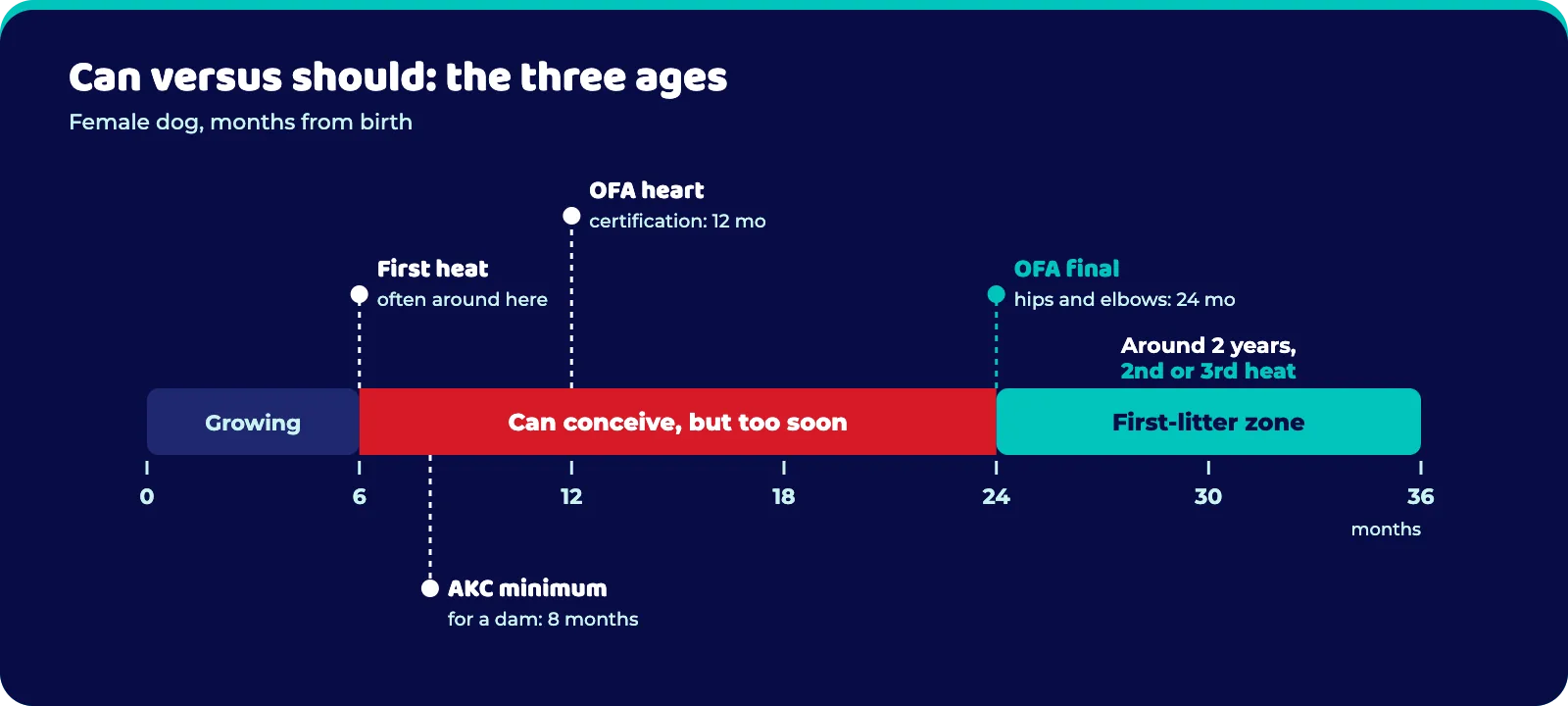
So when people ask how old should dogs be to have puppies, the useful answer is the responsible age. The first two are minimums, set by biology and by a registry's breeding age limits. Treating a minimum as a target is how young dogs end up carrying litters before they have finished growing.
How Old Do Female Dogs Have to Be to Breed?
Why her first heat is a warning sign, not a green light
If you want one number for how old do female dogs have to be to breed, use 2 years. The American Kennel Club's breeding experts describe a female as not developmentally or physically mature to be bred until around that age, with some toy and small breeds maturing by about 18 months.
Purdue University's canine welfare researchers reach the same place from a different angle. Their review of breeding limits advises waiting until the second or third heat cycle, and links breeding before a year of age with smaller litters and higher puppy mortality.
There are practical reasons too. Early cycles are often irregular, and VCA Animal Hospitals notes it can take up to two years for a dog's cycles to become regular. A young female may also have a split heat, where the signs start, stop and return a few weeks later. That makes timing a mating much harder and raises the odds of a missed breeding.
Waiting gives you something valuable: information. By her second or third heat you will know how long her cycles run, how obvious her signs are and how she handles the hormonal swings. That record makes timing her first breeding far more accurate.
Dog Breeding Age by Breed Size
Small dogs mature early. Giants take their time.
Dog breeding age is not one size fits all, because maturity is not. Purdue's review puts physical maturity at roughly 6 to 12 months for small breeds and 12 to 24 months for large breeds. Heat timing follows a similar pattern, and so does how often she cycles.
How size changes the timeline (general guidance)
Size | First heat | How often she cycles | Realistic first litter |
|---|---|---|---|
Toy and small | Often around 6 months, and as early as 4 or 5 months in some toy breeds | Usually twice a year, and up to three times a year in some small dogs | Around 18 months to 2 years, once she is mature and her screenings are complete |
Medium | Usually between the small and large ranges | About twice a year | Around 2 years, after final hip and elbow ratings |
Large | Often around 1 year or later | About twice a year, sometimes less often | 2 years or later, once her ratings are in |
Giant | Sometimes not until 18 months to 2 years | As little as once a year | Often well past 2 years, since her second heat can arrive late |
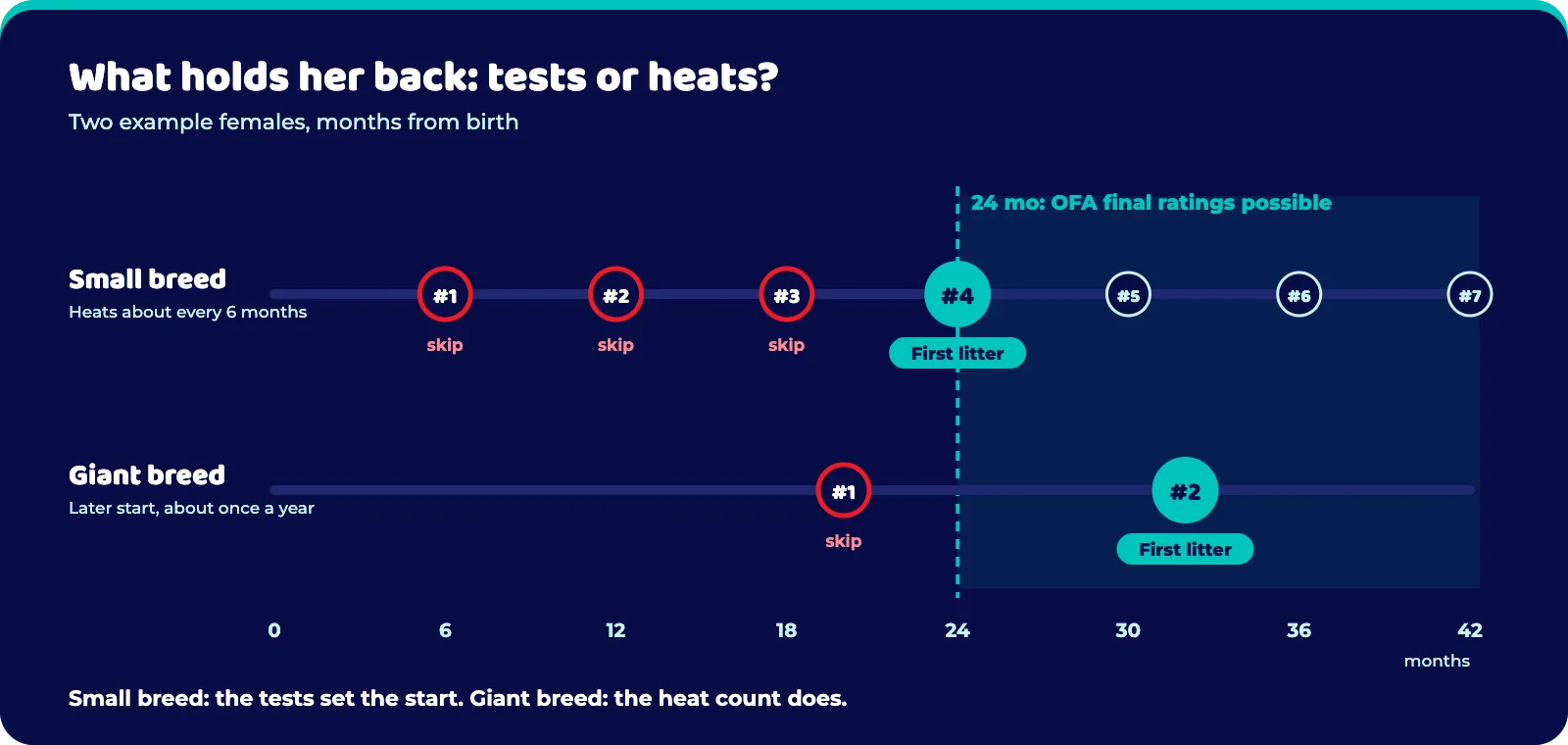
This is where the size question gets interesting. A toy female that cycles early and often may reach her third heat before her second birthday, so her health screenings are what hold you back. A giant female may reach 24 months before her second heat even arrives, so her heat count is what holds you back. Either way, the answer to how old should a dog be to breed is whichever of those two comes later.
Why OFA Age Minimums Set the Real Start Line
You cannot clear what you cannot test yet
The Orthopedic Foundation for Animals (OFA) runs the health databases most US breeders use to show their dogs are sound. Its age rules are strict: according to the OFA's own FAQ, a dog must be at least 24 months old for a final hip or elbow certification. Preliminary evaluations are available from 4 months up to 24 months. They are useful for early planning, but they are not a final rating.
That single rule answers a lot of questions. If a female is bred at 14 months, nobody can show a stud owner or a future puppy family her final hip or elbow result, because it does not exist yet. Careful stud owners often ask for those results up front, which is one reason our guide to questions to ask a stud dog owner works in both directions.
Common health clearances and their earliest ages
Screening | Earliest age | Notes |
|---|---|---|
Hips (OFA final) | 24 months | Preliminary evaluations available from 4 months |
Elbows (OFA final) | 24 months | Preliminary evaluations available from 4 months |
Heart (OFA cardiac) | 12 months | Minimum age for certification in either OFA cardiac database |
Eyes, knees and DNA tests | Varies by test | Follow your breed club's recommended list and ask your vet |
Canine brucellosis | Before every breeding | Test both dogs as part of a pre-breeding soundness exam |
Which tests she needs depends on her breed. Each breed's parent club sets its own recommended screenings, and OFA publishes them through its CHIC program. A dog earns CHIC certification once she has been screened for every test her parent club recommends.
When Is the Best Time to Breed a Dog?
Her age picks the right heat. Her hormones pick the right day.
Age tells you which heat to use. When is the best time to breed a dog within that heat is a separate question, and it is where many first-time breeders get caught out.
Most dogs come into heat about every six months, according to the AKC's heat cycle guide. The first stage, proestrus, averages about 9 days, followed by estrus, which also averages about 9 days. Both stages can run anywhere from 3 to 21 days, though, so counting days on a calendar is unreliable. Her fertile window runs from a couple of days before ovulation to about 5 days after.
That is why the AKC calls progesterone testing the most effective way for breeders to time ovulation. Your vet takes a series of blood samples during her heat and tracks the hormone as it rises, which pinpoints the days to breed. So if you are wondering when should you mate a dog, the answer is when her progesterone says so, not when the calendar does.
Once she is bred, pregnancy lasts about 63 days, so plan backwards from that as well. A litter due in the middle of a vacation or a house move is a problem you can avoid with a little forward thinking.
When to Breed a Dog: A First-Litter Plan in 6 Steps
From her first heat to her first litter
Here is the order responsible owners follow when planning a female's first litter. Each step depends on the one before it, so take them in sequence.
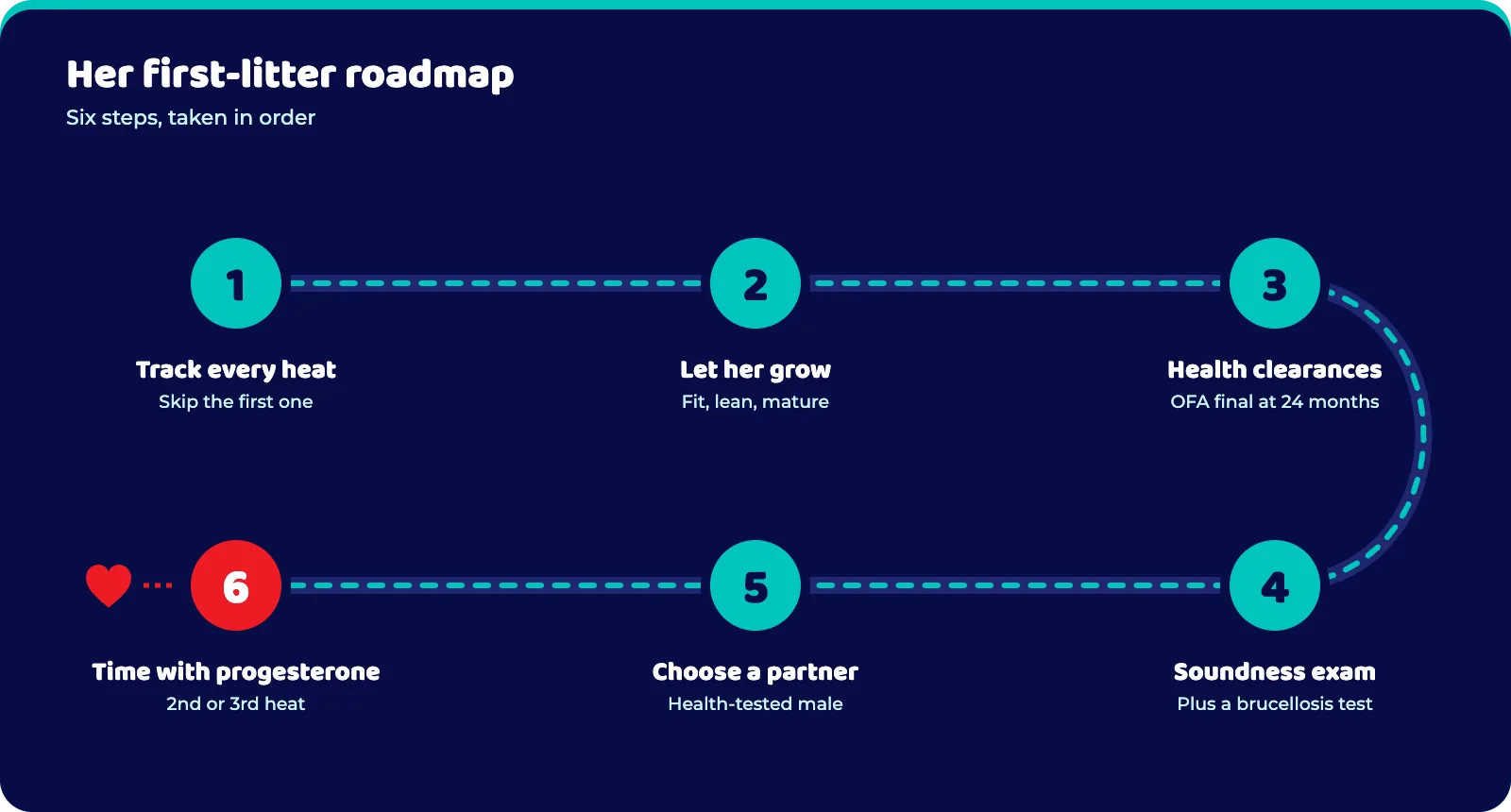
1Track every heat from the first one
Start your heat diary at her first cycle and let that heat pass without breeding. You are collecting data: cycle length, signs and how regular she is.
2Let her finish growing
Feed her for healthy growth, keep her fit and lean, and give her body time to mature. AKC breeding experts note that females in prime fitness and good body condition tend to whelp more easily.
3Complete her health clearances at 24 months
Book final OFA hip and elbow evaluations once she turns 2, along with the eye, heart and DNA tests her breed club recommends. Keep copies of every result.
4Book a breeding soundness exam
Ask your vet for a pre-breeding exam ahead of the heat you plan to use, including a brucellosis test. It is also a good time to review her vaccines and parasite control.
5Choose a health-tested partner
Look for a male whose results complement hers and confirm his brucellosis status too. The Petsfindly dog mate finder shows owners' shared health results so you can compare before you talk terms.
6Time it with progesterone on her second or third heat
Work with your vet on progesterone testing so you breed inside her fertile window, then plan for about 63 days of pregnancy and the weeks of puppy care that follow.
Interactive check
Is she ready for her first litter?
Tick everything that is true for her today. Nothing is saved or sent anywhere.
Let's see where she stands
Tick the boxes on the left to get your next step.
See the 6 stepsHow Many Litters, and When to Retire Her
A breeding career is short. Plan the ending at the start.
Thinking about the end of her breeding life is part of choosing the right dog breeding age at the start. Purdue's review notes that most kennel clubs and veterinary sources recommend no more than four to six lifetime litters, and that most guidelines advise against breeding dogs older than 6 years.
On back-to-back breeding, thinking has shifted. The Society for Theriogenology, as summarized by Purdue, considers breeding on consecutive heats acceptable as long as she keeps or regains a healthy body condition for her breed and a vet confirms her health before the next cycle. AKC breeding experts add a firm limit of no more than two consecutive heats without a cycle off. Some vets favor breeding a female more often while she is young and retiring her earlier, though Purdue notes more research is needed.
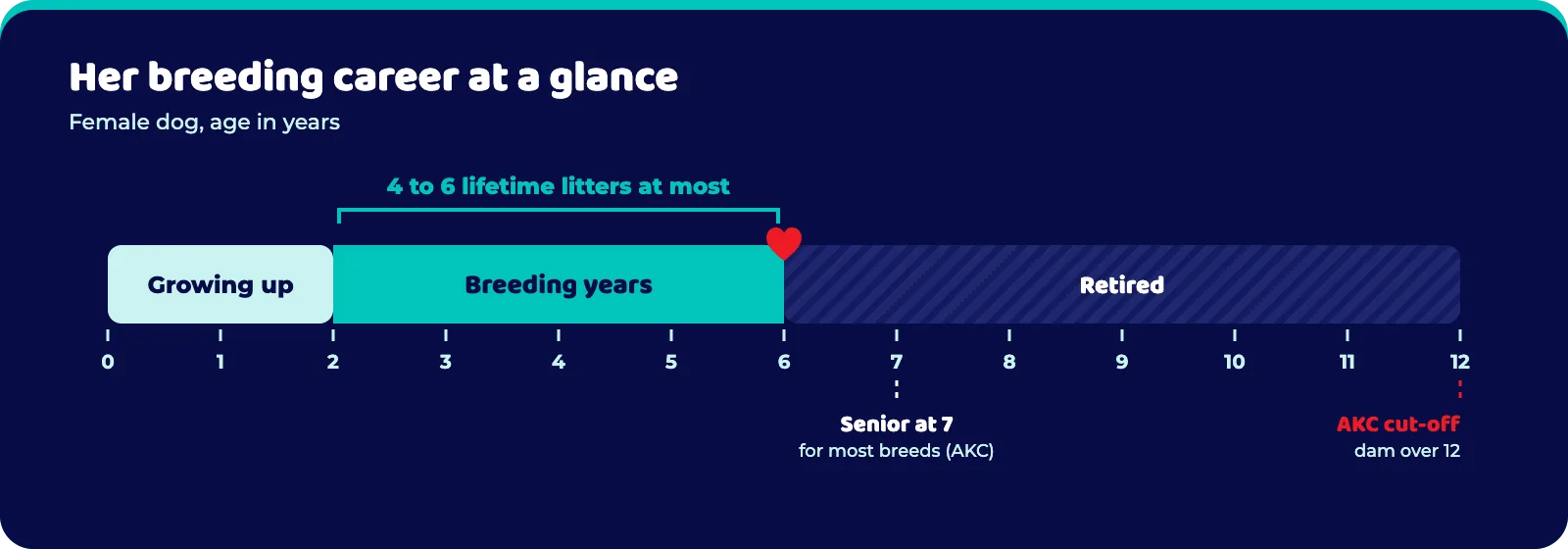
Her breeding career, stage by stage
Stage | Typical age | What to focus on |
|---|---|---|
Growing up | Birth to about 2 years | Healthy growth, training, a heat diary and preliminary screenings |
Breeding years | About 2 to 6 years | Final clearances, a soundness exam before each breeding, and no more than two consecutive heats without a break |
Retirement planning | Around 6 years, or sooner if your vet advises | A spay conversation with your vet and a comfortable retired life |
Registry cut-off | 12 years | The AKC will not register a litter from a dam over 12 on the date of mating |
The AKC's experts consider most breeds senior at 7, and say only females in excellent physical and nutritional condition, as judged by a vet, should be considered for breeding past that age. Fertility declines with age, and Purdue notes that older females face higher risks of prolonged labor, cesarean sections and uterine infections.
It is also why Petsfindly keeps its breeding matches inside a deliberately narrow age range. You can read the reasoning in why breeding windows are strict on purpose.
Breed Spotlights: How the Age Dogs Breed Shifts by Type
Four very different calendars
The age dogs breed responsibly varies most at the edges of the size range. These four examples show why one number never fits every dog.
Toy breeds: Chihuahua and Yorkshire Terrier
Toy females can have their first heat as early as 4 or 5 months, and the AKC notes that small females may mature by about 18 months. Even when she matures early, finish the screenings her breed club recommends, such as knee evaluations for many toy breeds, before her first litter. See Chihuahuas and Yorkshire Terriers on Petsfindly.
Large retrievers: Golden Retriever and Labrador Retriever
For these breeds, hips and elbows sit at the heart of health testing, so the 24-month OFA mark matters. Plan her first litter for a heat after her second birthday, once her ratings are in, and pair her with a male whose results are just as strong. Browse Golden Retrievers and Labrador Retrievers.
Giant breeds: Great Dane
Great Danes may not have their first heat until around 2 years old, according to the AKC. With a later start and sometimes fewer cycles a year, waiting for her second heat can push a first litter well past her second birthday. Patience pays off here, because giant breeds take longer to finish growing. Browse Great Danes.
The outlier: Basenji
Basenjis cycle only once a year, so her second heat arrives a full year after the first. VCA notes that basenjis and sled dog breeds are the ones with a set breeding season, typically in spring. Plan around a single annual window and book her health testing well ahead of it.
Dog Breeding Age FAQs
Quick answers to the questions owners ask most
Can a dog get pregnant on her first heat?
Yes. VCA notes that dogs can become pregnant on their very first cycle, which is why young unspayed females need close supervision during heat. Being able to conceive is not the same as being ready, and welfare guidance recommends waiting until her second or third heat.
Is 1 year old too young to breed a dog?
For most females, yes. Final hip and elbow ratings are not possible until 24 months, and Purdue's review links breeding before a year with smaller litters and higher puppy mortality. Even early-maturing toy breeds are usually closer to 18 months to 2 years before a first litter.
How old do dogs have to be to breed for AKC registration?
If you are asking how old do dogs have to be to breed for AKC papers, the dam must be at least 8 months and no more than 12 years old on the date of mating, and the sire at least 7 months and no more than 12 years. Those are registration limits, not health recommendations.
How many times a year can a female dog be bred?
Most females cycle about twice a year. AKC breeding experts advise no more than two consecutive heats without a cycle off, and the Society for Theriogenology's guidance, as summarized by Purdue, calls for a vet check and a healthy body condition before each new cycle.
Is 5 or 6 too old for a first litter?
Not automatically for a healthy female, but it is late. Fertility declines with age, the AKC considers most breeds senior at 7, and most guidelines advise against breeding past 6. Get a thorough vet exam before you decide.
So what is the best age for a first litter?
Whether you search how old does dogs have to be to breed or ask your vet, the answer for most females is around 2 years old, on her second or third heat, with final health clearances complete and her vet's go-ahead.
The Bottom Line
Can is not the same as should
A female dog can conceive at her first heat, and the AKC will register a litter from 8 months. Neither number answers how old does a dog have to be to breed responsibly. For most females, that answer is around 2 years old, on her second or third heat, after final OFA clearances, a soundness exam with a brucellosis test and a progesterone-timed breeding.
Plan the whole arc up front: a heat diary from day one, a first litter around two, a firm limit on lifetime litters and back-to-back heats, and a retirement plan before she needs one. If she is still growing up, use the time well. Create a free profile for your dog now and get matched when she is ready.
Planning ahead
Get her matched when she is ready
Create a free profile for your dog now and get matched when she is ready. Every match shows why it fits, from breed and distance to the health results owners choose to share, and your phone number stays private until you decide to share it.
- Free to browse
- Phone-verified owners
- We never take payments
Further reading
- American Kennel Club: Litter registration glossary, breeding age limits
- Orthopedic Foundation for Animals: Frequently asked questions
- Orthopedic Foundation for Animals: CHIC programs
- American Kennel Club: How long are dogs in heat?
- American Kennel Club: Steps to prevent pregnancy problems in bitches
- American Kennel Club: Pregnancy in dogs
- VCA Animal Hospitals: Estrus cycles in dogs
- Purdue University Canine Welfare Science: Breeding limits and welfare
- Cornell Riney Canine Health Center: Canine brucellosis
This guide is general information for dog owners and is not veterinary or legal advice. Talk to your veterinarian before making any breeding or health decision for your dog.