In this guide
- What does progesterone in dogs actually tell you?
- Canine progesterone levels chart, stage by stage
- ng/mL or nmol/L? How to read the units on your report
- What should a dog progesterone level be to breed?
- When should progesterone testing for dog breeding start?
- How to time a breeding with progesterone tests for dogs
- Which progesterone test on dogs gives reliable numbers?
- What if progesterone levels for dogs stall or drop?
- How progesterone predicts her whelping date
- Does breed or size change the chart?
- Frequently Asked Questions
- The Bottom Line
Assuming both dogs are healthy, a mistimed breeding is the most common reason a female doesn't get pregnant, according to veterinarians writing for the American Kennel Club. The fix is a simple blood test repeated every few days during her heat. This guide turns those results into something you can use: a canine progesterone levels chart you can read at a glance, the math for converting lab units, a step-by-step testing plan, and the warning signs that mean you should call your vet before the stud ever arrives.
Key takeaways
Watch the climb, not one number
Ovulation shows up as a steady rise from under 1 ng/mL to about 5 to 6 ng/mL across several tests.
Eggs need two more days
Canine eggs mature roughly two days after ovulation, so breeding dates count forward from that point.
Stick with one lab
Different analyzers can report different numbers for the same blood, so keep a whole series on one machine.
It predicts the due date too
Counted from the LH surge, most females whelp within two days of day 65, which helps with C-section planning.
What does progesterone in dogs actually tell you?
Why one blood hormone is the best window into an event you can't see
Progesterone in dogs behaves differently than in most mammals. In many species it rises only after the egg is released. In a female dog, the follicles start producing it before ovulation, so the level begins creeping up while she is still in heat. Researchers at the Virginia-Maryland College of Veterinary Medicine describe this early rise as unique to the species, and it is exactly what makes testing useful: the progesterone dogs produce before ovulation lets a vet see the event coming instead of guessing after the fact.
The actual trigger for ovulation is luteinizing hormone, or LH. It peaks for a short time and is released in pulses, so catching it takes daily blood draws. Progesterone climbs steadily instead, which is why most breeders track it every couple of days and use it to work backward to the LH surge and forward to ovulation.
Outward signs only take you so far. Swelling, discharge color and a female's willingness to stand all shift during heat, but they vary a lot from dog to dog. Dr. Emmanuel Fontaine, a reproduction specialist writing for the AKC, describes females that ovulated as early as six days into their cycle and others that ovulated 30 days in. No calendar rule covers that range. A blood test does.
Canine progesterone levels chart, stage by stage
The ranges most labs use, and what each one asks you to do next
Typical progesterone levels dogs show at each stage of heat are listed below. The ranges come from IDEXX's interpretation guide for its in-clinic analyzer, cross-checked against published veterinary research. Treat this dog progesterone level chart as a map of the sequence, not a rulebook, because your vet will read your results against the specific lab or machine that produced them.
Table 1. Dog progesterone levels chart by heat stage (ng/mL)
Progesterone (ng/mL) | What's happening | Typical next step |
|---|---|---|
Under 1.0 | Baseline. The LH surge hasn't started. | Retest in about 3 to 4 days. |
1.0 to 1.9 | Early rise, before the LH surge | Retest in about 2 days. |
2.0 to 3.0 | LH surge, often called day 0 | Retest in 2 days to confirm the rise continues. |
3.1 to 4.9 | After the surge, before ovulation | Keep testing every other day. |
About 5 to 6 (range 4 to 10) | Ovulation | Your vet sets breeding dates from here. |
Above 10 | Eggs maturing and the fertile period opening | Breed on the schedule set for your semen type. |
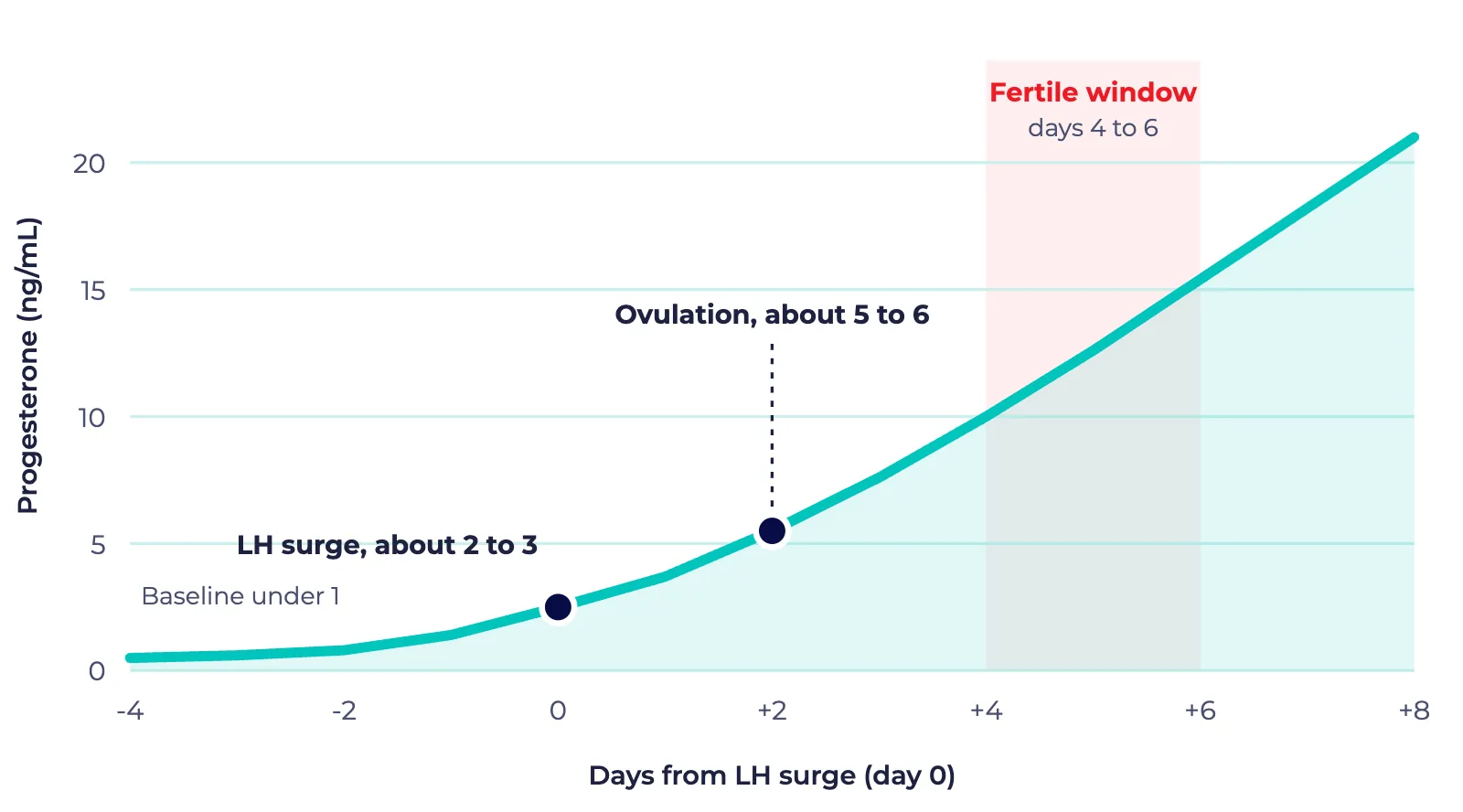
Once ovulation passes, the numbers keep rising for weeks. The Virginia-Maryland researchers note that peak levels later in the cycle can land anywhere between 15 and 80 ng/mL. That's why a single high reading can't tell you much on its own. What matters is where it sits in the series of tests that came before it.
ng/mL or nmol/L? How to read the units on your report
The same blood sample can produce two very different-looking numbers
Labs report progesterone dog levels in one of two units: nanograms per milliliter (ng/mL) or nanomoles per liter (nmol/L). The same result looks about three times larger in nmol/L, which is how breeders end up worrying over a 15 that is actually a normal ovulation reading. Michigan State University's Veterinary Diagnostic Laboratory, which reports in nmol/L, gives the conversion: multiply ng/mL by 3.18 to get nmol/L, or divide nmol/L by 3.18 to get ng/mL.
Table 2. Converting progesterone levels in dogs between units
ng/mL | nmol/L (x 3.18) | Where it usually falls |
|---|---|---|
1 | 3.2 | Top of baseline |
2 | 6.4 | LH surge range begins |
3 | 9.5 | Top of the LH surge range |
5 | 15.9 | Ovulation range |
10 | 31.8 | Eggs maturing |
20 | 63.6 | A level some vets use for chilled or frozen semen |
Units are only half the story. Analyzers aren't identical either. Dr. Fontaine points out that a reading of 5 to 6 ng/mL on one machine might show up as 4 to 5, or 8 to 10, on another. Your vet's interpretation is tuned to the equipment they use, so run every test in a series through the same lab or in-clinic analyzer, ideally with blood drawn at the same time of day.
What should a dog progesterone level be to breed?
Why the right answer is a day, not a number
It's the question every breeder asks, and the honest answer surprises people. What should a dog progesterone level be to breed depends on when she ovulated, not on a target value. Dr. Fontaine explains that when fertility is at its best, progesterone might read around 10, around 30, or even above 60 ng/mL, so no single figure marks the perfect moment. The test tells you when ovulation happened. Your breeding dates count forward from there.
The reason is biology. Canine eggs are released immature and need about two days before they can be fertilized. Sperm survival then decides how early you can breed. Fresh semen lives for several days inside the female, so natural matings have some room for error. According to Dr. Jane Barber, a board-certified theriogenologist, chilled sperm survive roughly one to three days once inseminated and frozen-thawed sperm only about half a day on average, which is why frozen breedings demand the tightest timing of all.
Table 3. Typical breeding timing by semen type
Semen type | When vets commonly breed | Why the timing differs |
|---|---|---|
Natural mating or fresh AI | Once progesterone reaches about 5 to 10 ng/mL, often repeated over the next few days | Fresh semen survives long enough to wait for the eggs to mature |
Fresh chilled (shipped) | About 2 to 3 days after ovulation | Chilled sperm live a shorter time, so they go in closer to egg maturity |
Frozen-thawed | About 3 days after ovulation, or days 4 to 6 after the LH surge | Frozen sperm survive the shortest time and must meet mature eggs |
If you're working with a stud owner, share the plan early. Our guide to the questions to ask a stud dog owner before breeding covers shipping, timing and what happens if she doesn't take, and you can read why breeding windows on Petsfindly are strict on purpose.
When should progesterone testing for dog breeding start?
Starting a little early costs one blood draw. Starting late can cost the litter.
Most reproduction vets want a first sample within the first week or so of heat, counting day 1 as the first day you notice swelling or bloody discharge. Advice varies slightly. Dr. Fontaine suggests about day 6, Iowa State University's theriogenology service recommends 5 to 7 days after the first signs, and other AKC contributors suggest 7 to 10 days. The goal of progesterone testing for dog breeding at this stage is a baseline, so you can see the climb the moment it starts.
After that, the number sets the pace. A low result usually means you can wait three to five days. Once the level starts to rise, most vets move to every other day until ovulation is confirmed, and Dr. Fontaine notes it usually takes at least three or four tests to pin it down. If you're fitting progesterone tests for dogs around work or travel, ask your clinic how they handle short-notice appointments before her season arrives.
How to time a breeding with progesterone tests for dogs
A six-step plan from her first signs to breeding day
This is the plan most breeders follow with their vet. Expect your vet to adjust each step for her history, her breed and the semen you're using.

1Line up your vet and your stud before her season
Choose a vet comfortable with reproduction work, ask which lab or analyzer they use, and agree on semen type and shipping with the stud owner. If you're still looking, Stud my dog and the dog mate finder let you compare stud owners who share their dogs' health results.
2Mark day 1 and book a baseline test
Day 1 is the first day you see swelling or bloody discharge. Book the first blood draw for around day 5 to 7 so you have a starting point.
3Retest every two to four days while she's low
While results stay under about 1 to 2 ng/mL, spacing tests a few days apart keeps costs down without missing the rise. Use the same lab every time.
4Move to every other day once the climb starts
The first reading of about 2 to 3 ng/mL marks the likely LH surge. Write that date down as day 0, because both your breeding dates and her due date build on it.
5Confirm ovulation with a continued rise
Keep testing until the level clearly rises past about 5 ng/mL and keeps going, as IDEXX's guidance recommends. Don't stop at the LH surge, since some heats rise and then fall back.
6Breed on your vet's schedule and log the dates
Your vet turns the ovulation estimate into breeding dates for your semen type (see Table 3). Record each breeding and keep your test log for the due-date estimate.
Which progesterone test on dogs gives reliable numbers?
Reference labs, in-clinic analyzers and home kits aren't equal
A progesterone test on dogs is an ordinary blood draw, but where the sample goes changes how fast and how precise the answer is. The AKC's chief veterinarian, Dr. Jerry Klein, calls radioimmunoassay the gold standard and notes it is mostly found at veterinary teaching hospitals and large reference labs. Some clinics run chemiluminescence tests that return results in about an hour, and many now have quantitative analyzers that report during the visit.
Progesterone is the same molecule in every mammal, so the progesterone test canine patients get doesn't need a dog-only chemistry. Dr. Fontaine notes that most machines used for dogs were first developed for human medicine. What matters is that the method is quantitative, checked against dog samples, and read by someone who knows that machine's quirks.
Table 4. Comparing progesterone tests for dogs
Test type | Where it's done | Speed | Best use |
|---|---|---|---|
Radioimmunoassay (RIA) | Teaching hospitals and large reference labs | Often slower, since samples may be shipped | Gold-standard accuracy |
Chemiluminescence | Reference labs and some clinics | About an hour at some clinics | Routine serial testing |
In-clinic quantitative analyzer | Many general and reproduction practices | Same visit | Fast serial results when used consistently |
Home or color-change kits | At home or in clinic | Fast | Rough screening, not chilled or frozen timing |
What if progesterone levels for dogs stall or drop?
Patterns that mean it's time to call your vet
Not every heat follows the textbook curve. Sometimes progesterone levels for dogs rise toward ovulation and then fall back. Dr. Fontaine calls this an anovulatory cycle: the follicles grow, then shrink without releasing eggs, and she can't get pregnant that heat. He describes one female who reached 4.9 ng/mL before dropping. That's why testing continues until ovulation is confirmed, not just until the LH surge.
A plateau is the other pattern to watch. After ovulation, the level should keep climbing. If it stalls around the same value, he advises close follow-up, and if it stays flat for more than about three days, an ovarian ultrasound to rule out a cyst.
Finally, don't assume her timing repeats. Dr. Fontaine reports that ovulation timing can vary by up to 40 percent between cycles, so a female who ovulated on day 17 last time may not do so again. Test every heat you plan to breed.
How progesterone predicts her whelping date
The same test results help you get ready for the puppies
Your testing log keeps paying off after the breeding. In a study published in Theriogenology, Kutzler and colleagues counted 65 days from the first preovulatory rise in progesterone, the LH surge reading. The prediction was right within two days for 90 percent of females and within three days for all of them, regardless of body weight or litter size. That's a much tighter estimate than counting from a mating date, since matings can happen days before or after ovulation.
That precision matters most for females who may need a C-section. Dr. Gail McRae of The Ohio State University College of Veterinary Medicine told Purina Pro Club that knowing the LH surge and ovulation gives a three-day window for the due date, which is why she recommends progesterone testing for those females.
During pregnancy, progesterone stays high. The Virginia-Maryland researchers note that a pregnancy is at risk if levels fall below 2 ng/mL, the threshold for maintaining it. Any decision about progesterone support belongs to your vet, so never supplement on your own.
Does breed or size change the chart?
The ovulation number holds steady. The planning around it doesn't.
Dr. Fontaine notes that females ovulate at about the same progesterone level whatever their size, from a Chihuahua to a Mastiff. The chart stays the same. What changes is the planning around it.
Yorkshire Terriers and other toy breeds
Small females follow the same curve, so don't expect a lower ovulation number because she weighs a few pounds. If you're comparing Yorkshire Terrier partners in other states, your timing also decides whether shipped chilled semen is realistic, since it has to arrive close to the post-ovulation window.
German Shepherd Dogs and large breeds
Larger breeds tend to have their first heat later, according to AKC veterinary contributors, but once she's cycling the progesterone landmarks don't move. For German Shepherd Dog breedings using frozen semen from a distant stud, the tight frozen timing in Table 3 applies just the same.
French Bulldogs and flat-faced breeds
For breeds where your vet may recommend a planned C-section, like the French Bulldog, progesterone testing earns its keep twice: once for breeding day and again for a due date your vet can schedule around. Talk through delivery plans before she's bred, not after.
Frequently Asked Questions
Quick answers to common progesterone questions
How many progesterone tests does a dog need per heat?
Usually at least three or four, according to Dr. Fontaine, and more if she ovulates late in her heat. Low early results can be spaced three to five days apart, then every other day once the level starts rising.
What is a normal progesterone level for dogs at ovulation?
About 5 to 6 ng/mL, with published research putting the range at 4 to 10 ng/mL. In nmol/L that's roughly 16 to 19. Always check which unit your lab uses before comparing numbers.
Can I use a home kit to measure progesterone for dogs?
Home kits that estimate progesterone for dogs by color change are less accurate than lab methods, according to the AKC's chief veterinarian. They can help with rough screening, but chilled and frozen semen breedings need quantitative testing through a vet.
When is the best time to breed after ovulation?
Dr. Klein of the AKC describes 48 to 72 hours after ovulation as the prime time, because that's when the eggs finish maturing. Natural matings with fresh semen can start a little earlier since sperm survive for several days.
Will she ovulate on the same day next heat?
Not necessarily. Ovulation timing can vary by up to 40 percent between cycles, so a past heat is only a rough guide. Plan to test every cycle you intend to breed.
Is progesterone testing worth it for a natural mating?
Yes, for most breeders. A mistimed breeding is the most common reason a healthy female doesn't conceive, and the same results give you a far more accurate due date if she does.
The Bottom Line
Read the series, count from ovulation
A canine progesterone levels chart is most useful when you read it as a story told over several tests: a baseline under 1 ng/mL, a rise through 2 to 3 for the LH surge, roughly 5 to 6 at ovulation, then about two days for her eggs to mature. Build your breeding dates from that ovulation estimate, match them to your semen type, and keep the whole series on one lab.
Call your vet the moment the numbers stop behaving. Every progesterone dog result you log this heat also sets you up for a calmer due date and a better plan next time.
Planning a litter?
Find a stud that fits her timing
Compare breeding partners, review the health results owners share, and talk timing with stud owners before her season starts.
- Free to browse
- Phone-verified owners
- We never take payments
Further reading
- American Kennel Club: 20 Facts You Should Know About Timing of Ovulation in the Bitch
- American Kennel Club: Progesterone Testing in Dogs, When to Do It and How Often
- Michigan State University Veterinary Diagnostic Laboratory: Assessment of Reproduction
- Frontiers in Veterinary Science (Virginia-Maryland College of Veterinary Medicine): Progesterone measurement for timing bitches during breeding
- IDEXX: Catalyst Progesterone interpretation guide
- Society for Theriogenology proceedings: Fresh-chilled versus frozen artificial insemination in the bitch
- Iowa State University Theriogenology Service: Canine breeding management
- Kutzler et al., Theriogenology (2003): Accuracy of canine parturition date prediction
- Purina Pro Club: Taking the guesswork out of dog breeding with progesterone testing
- Whole Dog Journal: Progesterone test for dogs and the female dog heat cycle
This article is general education, not veterinary advice. Progesterone results must be interpreted against the lab or analyzer that produced them, so always plan breeding and pregnancy care with a licensed veterinarian. Breeding rules and permits vary by state and city, so check local requirements before you breed.