In this guide
- What Is a Double Merle Dog?
- What Does Merle Mean in Dogs?
- Why Double Merles Are Born Deaf or Blind
- The Merle Pairing Chart Every Breeder Should Save
- Cryptic Merle and Hidden Merle
- How to Read a Merle DNA Test Result
- Aussies, Border Collies, Great Danes and Frenchies
- Is Merle to Merle Breeding Ever Allowed?
- Double Merle Life Expectancy and Care
- Your Pre-Mating Checklist for Merle Dog Breeding
- Frequently Asked Questions
A double merle is a dog that inherited the merle gene from both parents. That second copy strips pigment from much of the coat, and often from the inner ear and the developing eye, which is why double merle dogs have a high risk of being born deaf, vision impaired, or both.
It almost always starts with one decision: pairing two dogs that each carry merle. The good news is that this is one of the most preventable problems in merle dog breeding. A cheek swab on both dogs before the mating tells you what you need to know.
I wrote this guide for breeders who love merle and want to keep producing it responsibly. You will find a plain-English explanation of the gene, a pairing chart you can save, breed notes for Aussies, Border Collies, Great Danes and French Bulldogs, and a checklist to run before any stud conversation.
Key takeaways
Two copies, one problem
A double merle (M/M) inherits one merle gene from each parent. One copy is a pattern; two copies is the risk.
Ears and eyes at risk
Double merles face a much higher chance of deafness and serious eye defects than single merles.
Looks can lie
Cryptic and hidden merles look solid but still pass merle on. Coat color is never proof.
One safe rule
Pair one merle with one DNA-confirmed non-merle, and no puppy can be a double merle.
What Is a Double Merle Dog?
The short answer, in one minute
If you are asking what is a double merle dog, here it is: a dog with the genotype M/M, meaning two copies of the merle allele, one from each parent. A typical merle dog has one copy (M/m). The AKC explains that double merles usually carry much more white than a normal merle, sometimes looking almost pure white, with smaller patches of color.
Double merles are produced when two merle carriers are bred together. That 25% chance per puppy comes straight from basic inheritance, not from bad luck.
Single merle vs. double merle at a glance
Trait | Single merle (M/m) | Double merle (M/M) |
|---|---|---|
Coat | Classic mottled merle pattern | Mostly white with small merle patches |
Hearing | Deafness in both ears under 1% (AKC) | 10% deaf in one ear, 15% in both (Strain, 2009) |
Eyes | Usually normal; blue eyes are common | Often small, malformed or nonfunctional eyes |
Skin | Normal pigment | Pink skin prone to sun damage |
Passes on merle | To about half of puppies | To every puppy |
What Does Merle Mean in Dogs?
A pattern, not a color, and a gene that behaves in surprising ways
People search what does merle mean in dogs because the word gets used loosely. Merle is a coat pattern of irregular dark patches on a lighter, diluted background of the same pigment. Black dogs with merle are called blue merle, and liver dogs with merle are called red merle.
One gene, many names
Breed | What the merle pattern is called |
|---|---|
Australian Shepherd, Border Collie, Sheltie | Blue merle or red merle |
Dachshund | Dapple |
Catahoula Leopard Dog | Leopard |
Great Dane | Merle, and the merle-based harlequin |
The pattern comes from a small piece of inserted DNA in a pigment gene called PMEL, also written SILV. The UC Davis Veterinary Genetics Laboratory (VGL) describes merle as incompletely dominant, which means one copy is enough to show the pattern. Shorter insertions produce little or no visible pattern, longer ones produce classic merle, and the longest can produce a dog that is almost entirely white.
VGL also reports that, although uncommon, a puppy can inherit a longer or shorter version than its parent carries. In practical terms, a parent's coat is never a guarantee of what its puppies will carry.
Why Double Merles Are Born Deaf or Blind
Pigment cells do more than color the coat
Pigment cells come from the same early embryonic tissue that builds nerves, skin, eyes and ears. ASHGI explains that with two copies of merle, some cells end up with no pigment at all. In the inner ear, that leads to deafness. In the eye, structures can develop abnormally.
25%: Chance per puppy of a double merle from a merle to merle mating
15%: Double merles deaf in both ears in Strain's 2009 study
<1%: Chance a single merle is deaf in both ears (AKC)
The best-known study, by George Strain and colleagues at Louisiana State University in 2009, hearing-tested 153 merle dogs from 10 breeds. Among the double merles, 10% were deaf in one ear and 15% in both. One copy is a pattern. Two copies is a gamble.
Eyes are the other big concern. The AKC reports that double merles often have microphthalmia, meaning eyes that are abnormally small and frequently nonfunctional, along with abnormal pupils. ASHGI adds that in a few severe cases the eyes were missing entirely.
Severity varies by breed and by how much white the dog carries. VGL notes that double merles in breeds with little white spotting, such as the Catahoula Leopard Dog, show fewer ear and eye defects, and ASHGI's deafness guidance links white on and around the ears to hearing loss.
The Merle Pairing Chart Every Breeder Should Save
Know the outcome before the dogs ever meet
Every puppy gets one gene copy from each parent. The two squares below show what that means for the two pairings breeders ask about most.
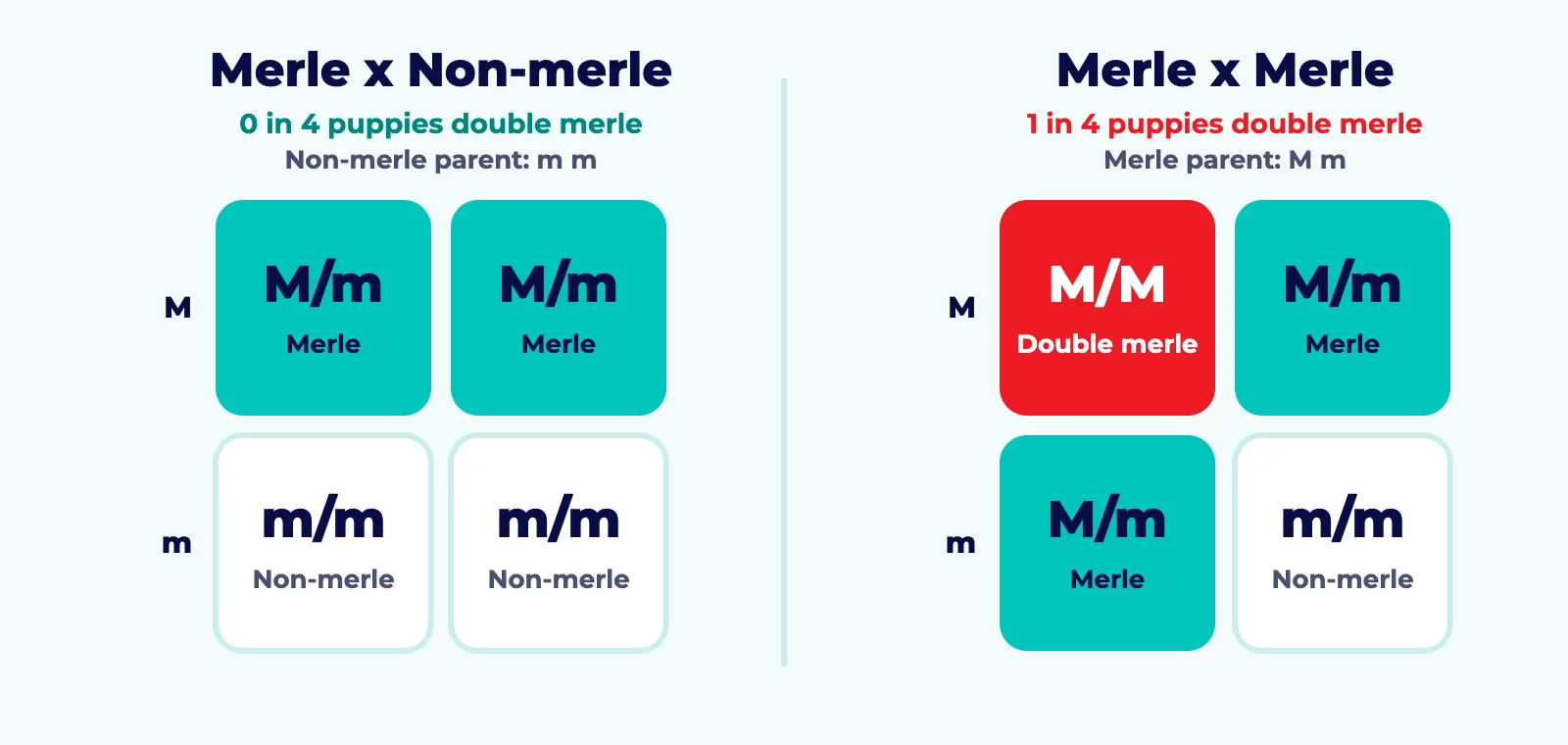
Every merle pairing, rated
Pairing | Non-merle (m/m) | Merle (M/m) | Double merle (M/M) | Verdict |
|---|---|---|---|---|
Non-merle x non-merle | 100% | 0% | 0% | Safe |
Merle x non-merle | About 50% | About 50% | 0% | Safe |
Double merle x non-merle | 0% | 100% | 0% | Discouraged |
Merle x merle | About 25% | About 50% | About 25% | Avoid |
Double merle x merle | 0% | About 50% | About 50% | Avoid |
Any merle allele x any merle allele | Varies | Varies | Possible | Avoid |
Cryptic Merle and Hidden Merle
How a "solid" dog ends up in a merle to merle litter
Most accidental merle to merle litters happen because one parent did not look merle. There are two ways that happens, and they are easy to confuse.
Two carriers you cannot see
Cryptic merle | Hidden merle | |
|---|---|---|
What it is | A short merle insertion that shows little or no pattern | A full merle gene masked by an e/e (recessive red) genotype |
How the dog looks | Solid, or a tiny merle patch you would only find by searching | Red, yellow or cream with no visible merle |
Can it pass on merle? | Yes | Yes |
How to catch it | Merle DNA test | Merle test plus MC1R (E locus) test |
The AKC describes cryptic merle patches as sometimes so small you would only notice them by checking the whole dog, and VGL confirms that e/e dogs do not show merle but can still produce merle puppies.
How to Read a Merle DNA Test Result
What those numbers on your lab report mean
DNA testing for merle uses a simple cheek swab. At UC Davis VGL the merle test is listed at $58, with a turnaround of at least 15 business days, and puppies should be at least three weeks old before swabbing. Prices and timelines change, so check the lab's page before you order.
VGL reports merle results by insertion size rather than by labels like Mc or Mh, because different research groups drew the boundaries in different places.
Reading a VGL merle result
Result on the report | What it means | Safe partner |
|---|---|---|
N/N | No merle insertion; cannot pass merle on | Any dog, from a merle standpoint |
N/### | One merle copy (a number from 200 to 280); lower numbers often show little pattern | A DNA-confirmed N/N dog only |
###/### | Two merle copies, a double merle genotype | No merle carrier; talk to your vet first |
Three results | The insertion changed size in some cells; VGL says the effect cannot be predicted | Consult a veterinary geneticist |
Aussies, Border Collies, Great Danes and Frenchies
Same gene, different stakes in every breed
The AKC lists merle as accepted and commonly found in breeds including the Australian Shepherd, Collie, Shetland Sheepdog, Dachshund, Cardigan Welsh Corgi, Great Dane, Catahoula Leopard Dog, Chihuahua, Border Collie and Pomeranian. Research cited by the AKC shows the merle gene is the same mutation in every breed.
Australian Shepherd: Merle accepted. Watch for hidden merle in red lines.
Border Collie: Merle accepted. Watch for merle hiding in working pedigrees.
Great Dane: Merle shown since 2019. Every harlequin is also a merle carrier.
French Bulldog: Merle disqualified. Watch for trend-driven merle pairings.
The Double Merle Aussie
The breed where most people first meet the problem
The double merle aussie is the textbook case. ASHGI describes Australian Shepherd double merles as usually carrying excessive white, being deaf in one or both ears, and often having serious, generally blinding eye defects. A double blue merle puppy, born to two blue merle parents, is the most common way buyers encounter one. Aussie breeders also work with red (e/e) lines, so hidden merle is a real risk. Test every breeding dog, including the tris.
The Double Merle Border Collie
Working lines carry merle too
A double merle border collie carries the same risks as a double merle Aussie. Merle is accepted in Border Collies, and plenty of working and sport lines carry it. If you are pairing two Border Collies and either one has merle anywhere in the pedigree, DNA test both before you book the mating.
Breeding Merle Great Danes
Harlequin depends on merle, which raises the stakes
Breeding merle Great Danes is more complicated than in any other breed. Harlequin, a classic Great Dane pattern, needs both the merle gene and a separate harlequin gene to appear, so every harlequin is also a merle carrier. Pairing two harlequins, two merles, or a harlequin with a merle is a merle to merle pairing, and it can produce a double merle great dane.
The Great Dane Club of America allowed merle Danes into AKC conformation starting January 1, 2019, and the club's breeders color code is being revised to reflect merle and newer genetic testing. Check the current version before planning a color-family breeding.
The Double Merle French Bulldog
A fashionable color with no place in the breed standard
A double merle french bulldog usually comes from the same story: two merle Frenchies bred together to chase a trendy coat. The French Bull Dog Club of America's breed standard lists merle as a disqualifying color. That does not make an existing merle Frenchie a bad pet. It does mean that anyone breeding for merle in this breed is working outside the standard, and two merle Frenchies should never be paired.
Is Merle to Merle Breeding Ever Allowed?
What US and UK clubs say
US vs. UK at a glance
United States | United Kingdom | |
|---|---|---|
Main guidance | AKC: not recommended to breed two merles | The Kennel Club: never knowingly carry out a mating that could produce affected puppies |
Merle to merle litters registered? | No registry ban found | Not registered |
Who enforces it | Breeders and breed club ethics | The registry |
I could not find a US registry rule that blocks puppies from a merle to merle breeding from being registered, so in the US the safeguard is the breeder's own choices. The Kennel Club in the UK goes further and refuses to register those litters.
Double Merle Life Expectancy and Care
For owners who already love one
If you share your home with a double merle, here is the honest picture on double merle life expectancy: I found no published study measuring lifespan in double merles. Nothing in the research I reviewed suggests the genotype itself shortens life, which is why ASHGI rejects the "lethal white" label. Day-to-day risks come from the disabilities, such as not hearing a car or missing a step, and from sun exposure on pink skin.
Everyday care for a double merle
Need | How to help |
|---|---|
Hearing | Ask your vet about a BAER hearing test; teach hand signals and touch cues |
Vision | See a veterinary ophthalmologist; keep furniture and routines consistent |
Skin | Offer shade and ask your vet about a pet-safe sunscreen for the nose and eye rims |
Safety | Use a leash or secure fencing near roads and water |
Deaf and blind dogs learn touch cues, scent markers and routines remarkably well, and communities like Deaf Dogs Rock share training ideas. Your veterinarian is the right person to build a care plan for an individual dog.
Your Pre-Mating Checklist for Merle Dog Breeding
Run through this before you send a single message
DNA test your own dogTest for merle even if your dog looks solid, red or cream.
Get the partner's original reportAsk for the lab report itself, not a screenshot or a verbal "he's not merle."
Confirm one dog is N/NIf both dogs show any merle number, stop there.
Check the E locusIn breeds with red or cream dogs, an MC1R result stops hidden merle slipping through.
Review the full health panelLook at OFA hips, elbows and eyes, plus breed-specific DNA tests.
Put it in writingAgree what happens if a puppy tests as a double merle.
Talk to your vetPlan BAER testing and eye exams for the litter before the mating.
For a deeper script, my guide to questions to ask a stud dog owner before breeding covers health, DNA and contract questions in detail.
Frequently Asked Questions
Quick answers to what breeders and owners ask most
Can two merle dogs ever be bred safely?
A merle to merle pairing always carries a chance of double merle puppies, about 25% per puppy when both parents carry one merle copy. Even cryptic carriers can pass on a longer allele. The safe approach is to pair a merle with a DNA-confirmed non-merle.
What does a double merle dog look like?
Most are mostly white with small patches of merle, often with blue or pale eyes and pink skin on the nose and eye rims. Some keep more color. A white dog is not automatically a double merle, so only a DNA test can confirm it.
Is a double blue merle the same as a double merle?
Yes. A double blue merle is a double merle from black-based, blue merle parents. The health risks come from the two merle copies, not the color.
Is merle the same as dapple?
Yes. Dapple is the Dachshund name for merle, and a "double dapple" Dachshund is a double merle with the same risks.
Merle is a beautiful pattern, and it deserves breeders who protect it. Health results on Petsfindly are shared by owners, so always ask to see the original certificate; the trust and safety page explains exactly what is checked and what is not. A test, a chart and one firm rule are all it takes: never two merles.
Check the pairing before you breed
Find a partner with shared health tests
On Petsfindly, profiles show breed, age, distance and the health tests owners choose to share, and every match explains why it fits. Add your dog's merle result to the profile and ask for the other dog's report before you go further.
- Free to browse
- Phone-verified owners
- We never take payments
Sources
- AKC: Merle in Dogs
- UC Davis Veterinary Genetics Laboratory: Merle test
- OMIA: Coat colour, merle in dogs
- ASHGI: Double Merle
- Deafness
- The Kennel Club: What is merle?
This guide is general education, not veterinary advice. Talk to your veterinarian or a veterinary geneticist before any breeding decision.