In this guide
- Can French Bulldogs Mate Naturally?
- Which Health Tests Do French Bulldogs Need Before Breeding?
- How Do You Breed French Bulldogs? 7 Steps
- How Does French Bulldog Breeding Artificial Insemination Work?
- Why Do Most French Bulldogs Need a C-Section?
- How Many Puppies Can a Frenchie Have?
- Blue, Lilac and Merle: What Color Means for Frenchie Breeding
- What Rules Apply When You Breed French Bulldogs?
- Frequently Asked Questions
- The Bottom Line
Anyone who has lived with a Frenchie knows the deal: a huge personality packed into a small, sturdy body. That same body is the reason French Bulldog breeding works so differently from breeding a Labrador or a Beagle.
If you searched can French Bulldogs mate naturally after a first attempt went nowhere, or you are still deciding whether to breed French Bulldogs at all, this guide gives you the straight version. It covers the anatomy, the health tests the breed club asks for, how artificial insemination and ovulation timing work, what a planned C-section involves and how many puppies to expect. If you are new to pairing dogs, start with Petsfindly's dog breeding hub.
Key takeaways
Natural is the exception
A natural tie can happen, but most Frenchie litters start with artificial insemination.
Book the C-section early
Frenchies face far higher odds of a difficult birth, so surgery is planned, not improvised.
Test before you pair
The breed club asks for hip, eye, knee and heart results, plus a breathing grade.
Color is not a goal
Blue, lilac and merle fall outside the AKC standard and bring real health risks.
Can French Bulldogs Mate Naturally?
Sometimes, but the breed's build works against it
Yes, occasionally. A healthy, keen pair can complete a natural tie, and some owners have watched it happen. You just cannot plan around it, and repeated attempts put both dogs under real strain. So when people ask can Frenchies breed naturally, the more useful question is whether they should try.
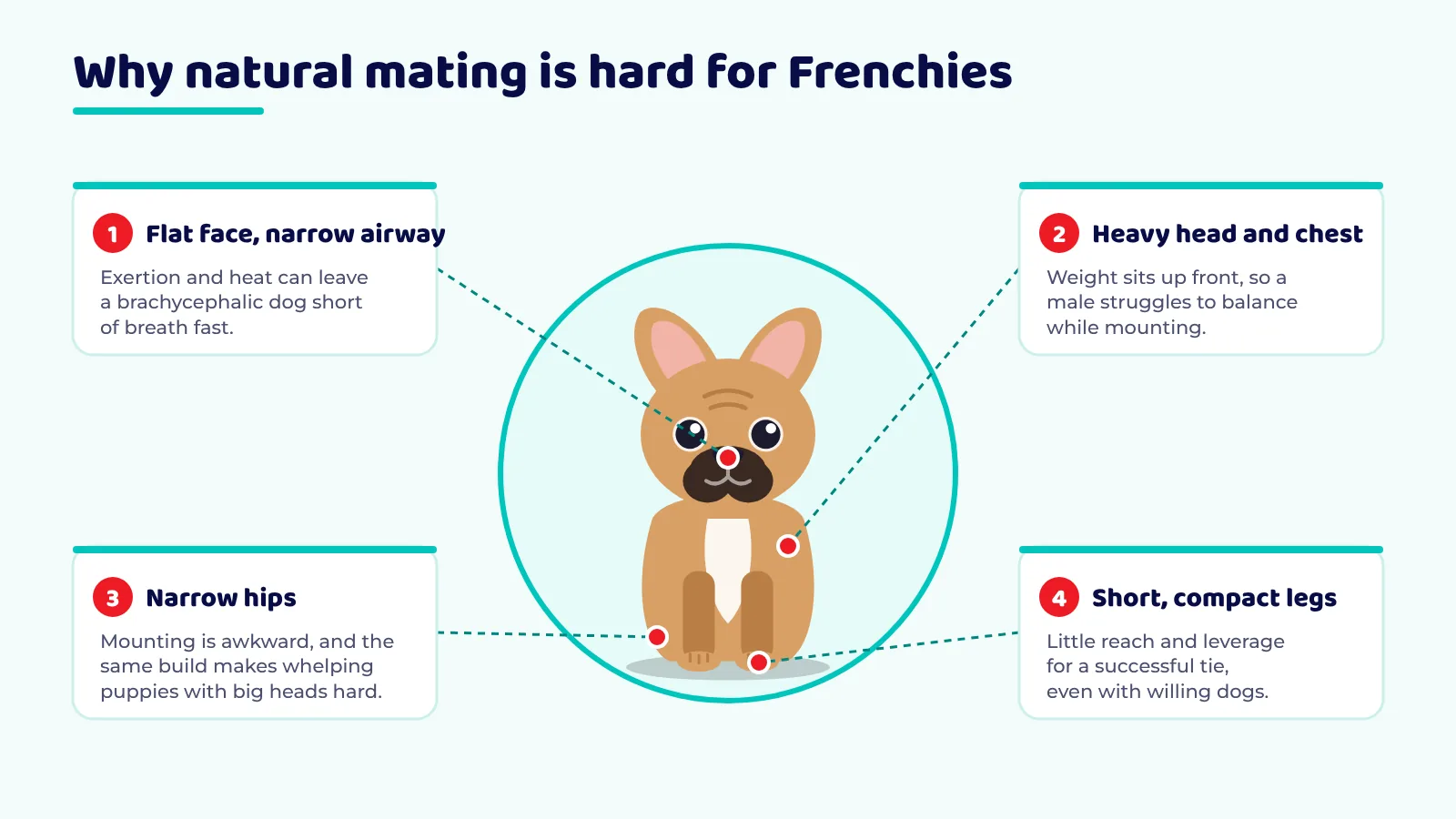
The trouble is the shape that makes the breed so lovable. French Bulldogs are brachycephalic, meaning their skulls are short and broad, which crowds the nose, soft palate and windpipe. Mating is hard physical work, and a flat-faced dog can overheat or run short of breath quickly, especially on a warm day. The male carries much of his weight in his head and chest, the female has narrow hips, and both have short legs, so getting into position and holding a tie is awkward for everyone involved.
French Bulldog natural breeding vs artificial insemination
Factor | Natural mating | Artificial insemination |
|---|---|---|
Physical strain | High. Mounting and the tie are strenuous for a flat-faced dog | Low. No mounting, and semen collection is quick |
Breathing and heat risk | Higher, especially in warm weather | Lower, since neither dog has to exert itself for long |
Distance | The dogs must meet in person | Chilled or frozen semen can be shipped from a stud far away |
Timing | Still depends on her ovulation, and failed attempts waste the window | Depends on ovulation too, but semen is placed exactly where it is needed |
AKC registration | Standard litter application | A separate AI litter application, with extra rules for chilled and frozen semen |
Which Health Tests Do French Bulldogs Need Before Breeding?
The breed club's list, plus the tests every breeding needs
Responsible Frenchie breeding starts months before the female comes into heat. The French Bull Dog Club of America (FBDCA), the breed's AKC parent club, sets the tests a dog needs to earn a Canine Health Information Center (CHIC) number through the Orthopedic Foundation for Animals (OFA). A CHIC number proves the tests were done and the results are public. It does not prove every result was good, so always read the results themselves.
French Bulldog health tests before breeding
Test | What it checks | Status |
|---|---|---|
Hip evaluation (OFA or PennHIP) | Hip dysplasia | Required for CHIC |
CAER eye exam | Inherited eye disease, examined by a board-certified veterinary ophthalmologist | Required for CHIC, with yearly rechecks advised |
Patellar evaluation | Kneecaps that slip out of place | Required for CHIC |
Cardiac evaluation | Inherited heart disease, by exam or echocardiogram | Required for CHIC |
Respiratory Function Grading | Breathing signs of brachycephalic obstructive airway syndrome (BOAS), graded 0 to 3 | Recommended by the FBDCA |
Juvenile hereditary cataracts (HSF4) DNA test | An inherited form of early cataracts | Recommended |
Cystinuria type 3 | A condition that causes urinary stones | Strongly suggested by the club |
Tracheal hypoplasia and elbows | A narrow windpipe and elbow dysplasia | Recommended |
Canine brucellosis | A contagious infection that causes infertility and pregnancy loss | Expected for both dogs before every breeding |
Age matters too. The OFA only issues final hip ratings once a dog is at least 24 months old, which is one reason many breeders wait until both dogs reach two before breeding French Bulldog pairs.
Interactive check
Is your Frenchie pair ready?
Tick everything that is true for both dogs today. Nothing is saved or sent anywhere.
Let's see where you stand
Tick the boxes on the left to get your next step.
See the 7 stepsHow Do You Breed French Bulldogs? 7 Steps
The order experienced Frenchie breeders follow
When people ask how do you breed French Bulldogs, or how do you breed a French Bulldog without putting her at risk, the answer is a sequence rather than a single event. Here is how to breed French Bulldogs responsibly, in the order that avoids the most expensive mistakes.
1Health test both dogs
Complete the CHIC tests, a breathing assessment and a brucellosis test for the female and the male. Keep the official reports, because a careful partner will ask to see them.
2Choose a complementary partner
Look for a mate whose strengths cover your dog's weak spots: easier breathing, sounder joints, a calmer temperament. Avoid close relatives and never pair two merles. Our list of questions to ask a stud dog owner helps you screen a male before you commit.
3Agree the terms in writing
Settle the stud fee or puppy terms, what happens if she does not conceive, who pays for semen shipping and who registers the litter. Petsfindly never handles payments, so the two owners agree these terms directly.
4Time her ovulation
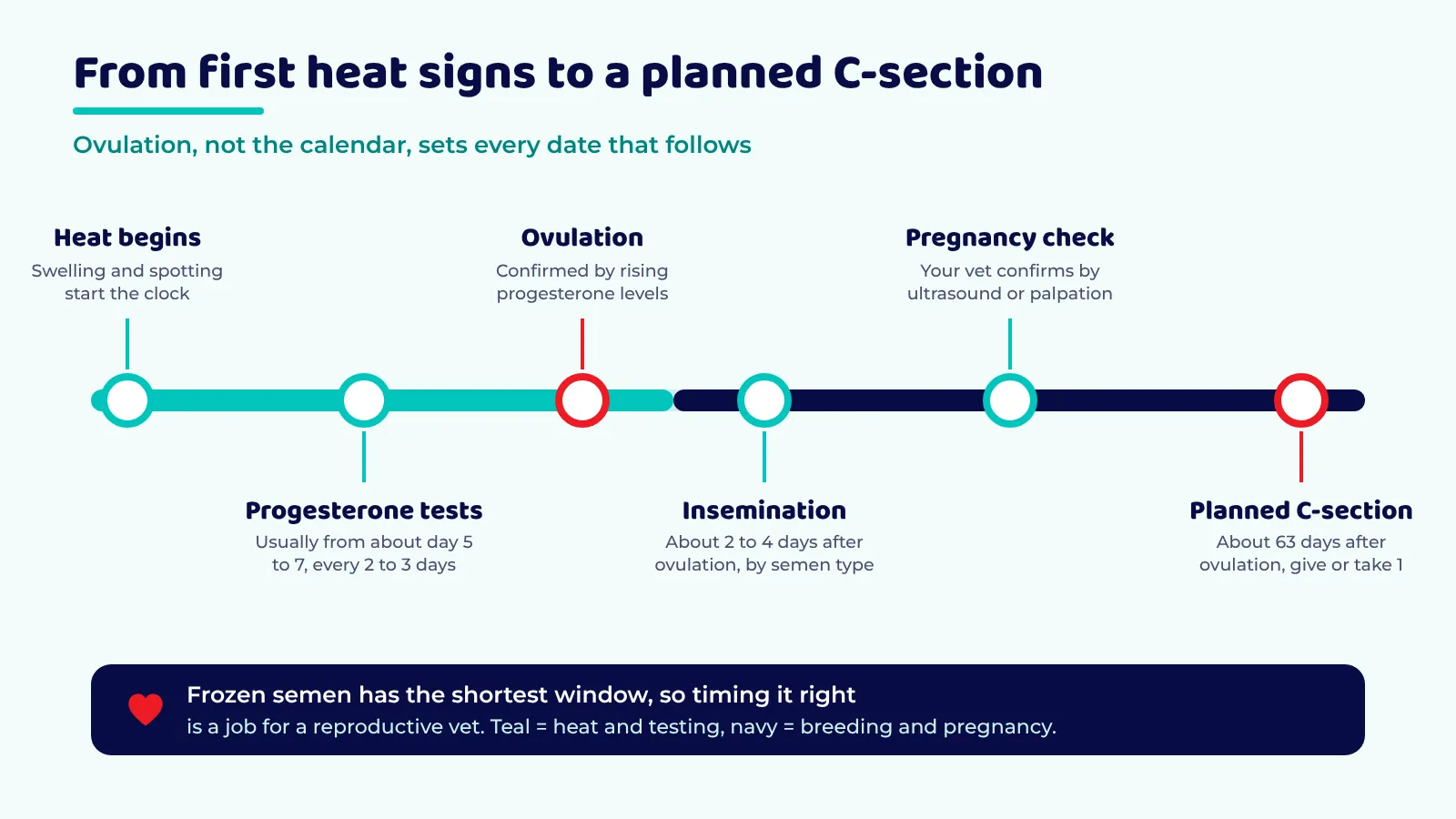
Ask your vet to start progesterone testing early in her heat, usually around day five to seven and then every two to three days, until her levels show ovulation. No step does more for your chances.
5Inseminate, or supervise a short natural attempt
Most Frenchie breeders use artificial insemination a few days after ovulation. If you do allow a natural attempt, keep it brief, cool and supervised, and stop at the first sign of breathing distress.
6Confirm the pregnancy and book the C-section
Your vet can confirm the pregnancy by ultrasound a few weeks later. Because you know her ovulation date, the surgery can be scheduled for roughly 63 days after it.
7Deliver and raise the litter
Have the surgical team, a warm whelping area and help at home ready. Mom will be recovering from anesthesia, so newborn puppies need close supervision while she nurses.
How Does French Bulldog Breeding Artificial Insemination Work?
Fresh, chilled or frozen, and why timing decides everything
Artificial insemination (AI) means collecting semen from the male and placing it in the female without a natural mating. For breeding French Bulldogs, it removes the most strenuous part of the process and lets you use a stud who lives across the country. Success depends on two things: the type of semen and how precisely you hit her fertile window.
According to Purina Pro Club, a dog's eggs need about two to three days after ovulation to mature, which is why breedings are timed after ovulation rather than at the first sign of heat. Fresh semen survives for several days, chilled semen for about two, and frozen semen for well under a day, so the margin for error shrinks as you move down that list.
Fresh, chilled and frozen semen compared
Semen type | How it works | Usual timing after ovulation | AKC registration notes |
|---|---|---|---|
Fresh | Collected and used the same day, with both dogs present | Days 1 and 3, days 2 and 4, or once on day 2 or 3 | A vet is not required, but an AI litter application is |
Chilled (fresh extended) | Collected, extended and shipped cold to the female's vet | Same windows as fresh | The sire must be AKC DNA certified |
Frozen | Stored in liquid nitrogen and thawed on the day | Around day 3 or 4 | Must be inseminated by a licensed veterinarian, with a DNA profile for the sire |
Vets place semen in one of three ways: vaginally, through the cervix with a scope (transcervical), or surgically into the uterus. Frozen semen usually calls for one of the last two, because it lives so briefly once thawed. Surgical insemination needs a general anesthetic, which carries extra risk for brachycephalic breeds, so ask your vet which method suits your female.
Why Do Most French Bulldogs Need a C-Section?
Big heads, narrow hips and a planned delivery date
A Frenchie puppy's broad head has to pass through its mother's narrow pelvis, and that mismatch is the main reason natural whelping so often stalls. A Royal Veterinary College VetCompass study of about 20,000 female dogs seen at UK emergency clinics found French Bulldogs were 15.9 times more likely than crossbreeds to suffer dystocia, the veterinary term for a difficult birth. Earlier research in the Journal of Small Animal Practice found that 81.3 percent of French Bulldog litters in its survey were delivered by C-section.
That is why most breeders plan an elective C-section rather than wait for labor. Knowing the ovulation date narrows the due date to a window of about three days, so the surgery can be booked with a full team on hand instead of rushed in the middle of the night.
Budget for it, too. Progesterone tests, insemination, ultrasound and surgery add up, and prices vary widely by region and clinic. Ask your vet for a written estimate before you breed so the C-section never becomes a financial surprise.
How Many Puppies Can a Frenchie Have?
Small litters are normal for the breed
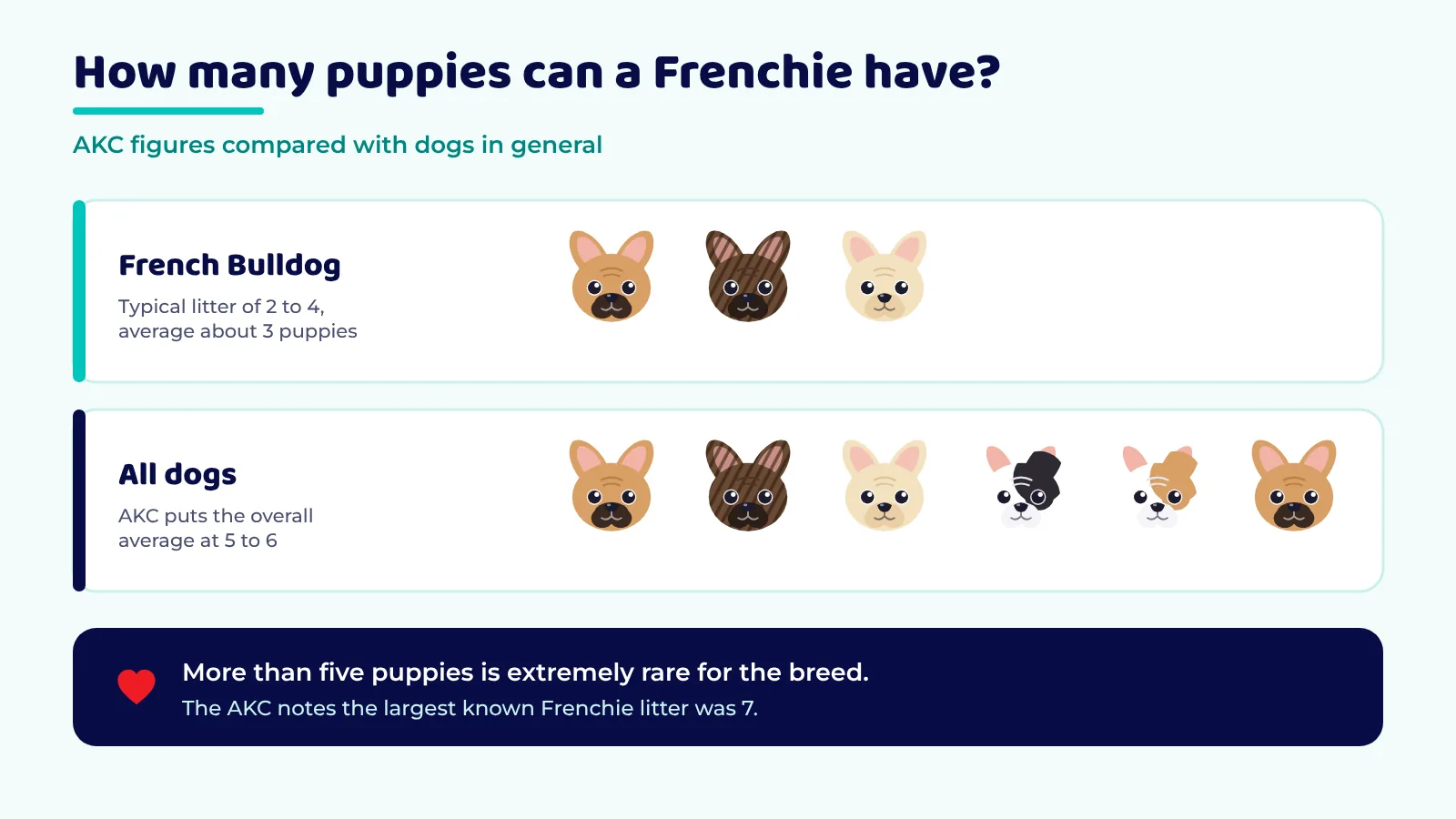
If you are wondering how many puppies can a Frenchie have, expect a small litter. The AKC puts the typical French Bulldog litter at two to four puppies, with three as the average, against five to six for dogs overall. It calls a litter of more than five extremely rare, and the largest it reports is seven.
Smaller dogs generally carry fewer puppies, and a first litter can be smaller than later ones. An x-ray late in pregnancy lets your vet count the puppies, so the surgical team knows when every one has been delivered. Age plays a part as well, which is one reason Petsfindly keeps its matching rules tight, as explained in why breeding windows are strict on purpose.
Blue, Lilac and Merle: What Color Means for Frenchie Breeding
Rare colors are not a breeding goal
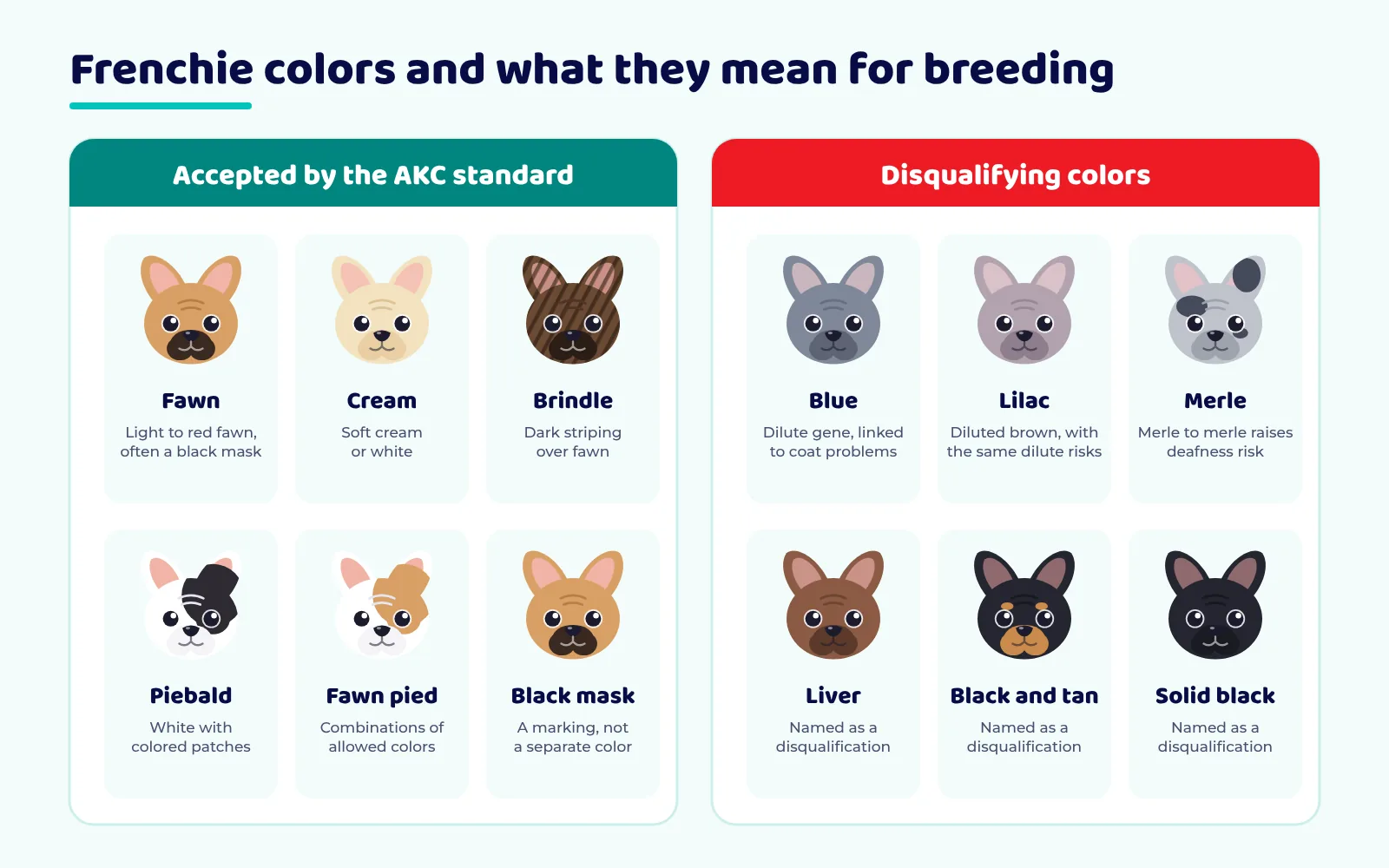
Unusual coats get attention online, which pulls some people toward pairing dogs for color rather than health. The AKC breed standard accepts white, cream and fawn in its shades, with brindle, piebald, black masks and white markings. It names colors such as solid black, black and tan, blue fawn, liver and merle as disqualifications, and states that any color outside the accepted list is disqualified as well. That rule covers blue and lilac.
Fawn, cream, brindle and pied
These are the colors the standard was written around, and none of them carries a color-linked health penalty. Choose between them on structure, breathing and temperament.
Blue and lilac
Both come from the dilute gene. Laboklin, a veterinary diagnostic lab, explains that dilute dogs can develop color dilution alopecia, a progressive hair loss prone to skin infections that can be managed but not cured, and it lists blue French Bulldogs among the breeds increasingly affected. No DNA test can predict which dilute dog will develop it.
Merle
Merle is outside the standard, and pairing two merles is a known welfare risk. A 2009 study in the Journal of Veterinary Internal Medicine found that 25 percent of double merle dogs were deaf in one or both ears, compared with about 3.5 percent of single merles.
What Rules Apply When You Breed French Bulldogs?
Registration, licensing and the agreement between owners
If you want AKC papers for the litter, the method matters. The AKC's artificial insemination rules require a specific litter application for any AI breeding. Fresh semen does not need a vet to inseminate, chilled semen requires an AKC DNA certified sire, and frozen semen must be inseminated by a licensed veterinarian with a DNA profile on file for the sire.
Licensing is the next layer. Federal USDA licensing can apply to breeders who keep more than four breeding females and sell puppies sight unseen, and many states, counties and cities add their own permits or limits. Check with your state agriculture department and local animal services before your first litter.
Finally, put the partnership in writing. A simple agreement covering fees, repeat breedings, health results and registration prevents most disputes. Petsfindly connects phone-verified owners but never takes payments, and our trust and safety page explains how members are checked.
Frequently Asked Questions
What Frenchie owners ask most
Can Frenchies breed naturally without any help?
Some can, but it is uncommon and physically demanding for a flat-faced breed. Most breeders use artificial insemination timed with progesterone testing, which spares both dogs the strain.
Can a French Bulldog give birth naturally?
It is possible, and some do, but French Bulldogs are far more prone to difficult births than mixed breeds. Most breeders schedule a C-section with their vet and treat a natural delivery as the exception.
How many puppies does a Frenchie have in her first litter?
Expect a small one. The AKC puts the breed average at about three, and first litters can be smaller than later ones.
How old should a French Bulldog be before breeding?
Many breeders wait until both dogs are at least two, partly because the OFA only issues final hip ratings from 24 months. Your vet can advise on your female's heat cycles and overall health.
Is French Bulldog natural breeding cheaper than AI?
French Bulldog natural breeding skips the insemination fee, but missed timing and failed attempts can cost you a whole cycle. Many breeders find progesterone-timed AI the more predictable route.
How do I find a health-tested French Bulldog stud?
Browse French Bulldogs open to breeding on Petsfindly and ask each owner to share OFA and breathing results before you agree to anything. See how it works for the full walkthrough.
The Bottom Line
Plan for the vet, not for luck
So, can French Bulldogs mate naturally? Occasionally. But successful French Bulldog breeding is rarely about letting nature take its course. It comes down to health-tested parents, precise ovulation timing, careful insemination and a C-section booked well before the due date.
Anyone who wants to breed French Bulldog puppies the right way puts the mother's safety first. Get that right and every other decision, from choosing a stud to planning the delivery, gets easier.
Ready to find the right match
Find a health-tested Frenchie stud
Browse French Bulldogs whose owners share their own health results, see why each match fits by breed and distance, and message without giving out your phone number.
- Free to browse
- Phone-verified owners
- We never take payments
Further reading
- French Bull Dog Club of America: Health testing and registries
- American Kennel Club: Official French Bulldog breed standard
- American Kennel Club: Average litter size
- American Kennel Club: Artificial insemination registration rules
- Royal Veterinary College VetCompass: French Bulldogs more prone to birthing problems
- Evans and Adams (2010): Proportion of litters of purebred dogs born by caesarean section
- Purina Pro Club: Progesterone testing for dog breeding
- The Kennel Club: Respiratory Function Grading scheme
- Laboklin: Colour dilution alopecia
- Strain et al. (2009): Deafness in dogs with the merle allele
- Orthopedic Foundation for Animals: Frequently asked questions
- American Kennel Club: USDA rule on pet breeder licensing
This guide is general information for dog owners and is not veterinary or legal advice. Talk to your veterinarian before any breeding decision, and check the breeding and licensing rules in your state and city.