
In this guide
- When Can You Breed Labs?
- Which Health Tests Do Labs Need Before Breeding?
- Labrador Dog Mating, Step by Step
- Gestation Period for a Labrador Retriever
- How Many Puppies Do Labs Have?
- How Labrador Coat Colors Are Inherited
- How to Breed a Silver Labrador, and Why It Is Debated
- English vs American Lab: Does Type Matter?
- Frequently Asked Questions
- The Bottom Line
Labradors make breeding look easy from the outside. They are friendly, sturdy and famously gentle with puppies, so it is no surprise that so many owners eventually wonder whether their own Lab should have a litter.
The reality is more involved. Good Labradors breeding starts long before two dogs meet, with health clearances that can't be finished until a dog turns two, DNA tests for conditions that run in the breed, and a real plan for every puppy. This guide answers the questions owners ask most: when to breed Labs, how many puppies to expect, how long pregnancy lasts and how coat color genetics actually work.
New to breeding in general? Petsfindly's dog breeding guide covers the basics for every breed. Everything below is specific to Labrador Retrievers.
Key takeaways
Two years first
Final OFA hip and elbow ratings need a dog at least 24 months old, so that is the realistic starting line.
Five core clearances
Hips, elbows, eyes, EIC and the dilute D locus are the tests the breed's CHIC program asks for.
About seven puppies
The AKC puts the average Labrador litter at seven, with five to ten typical and first litters often smaller.
63 days, give or take
Pregnancy runs about 63 days from ovulation, and progesterone testing pins down when the clock starts.
When Can You Breed Labs?
Fertile early does not mean ready
Labradors can be fertile well before their first birthday. The AKC will register a litter from a dam as young as 8 months and a sire as young as 7 months, with an upper limit of 12 years for both on the date of mating, according to its litter registration rules. Those are paperwork limits, not a recommendation.
The practical starting point is two years. The Orthopedic Foundation for Animals only issues final hip and elbow ratings once a dog is 24 months old, and the Labrador Retriever Club's breeder code of conduct asks members for those clearances at or after that age. Until then, nobody can say with confidence how a young Lab's joints will hold up, which matters in a breed this active and this solidly built.
Labrador breeding age at a glance
Milestone | Female | Male | What it means |
|---|---|---|---|
AKC registration minimum | 8 months | 7 months | The litter can be registered. It says nothing about readiness. |
Final OFA hips and elbows | 24 months | 24 months | The earliest point full joint clearances exist. |
Current eye clearance | Within 1 year of breeding | Within 1 year of breeding | The LRC asks for an eye exam by a board-certified ophthalmologist. |
AKC registration maximum | 12 years | 12 years | The registry cutoff on the date of mating. |
Reading her heat cycle
Most female dogs come into heat about every six months. The AKC explains that she is receptive during estrus, which lasts about nine days on average but can run anywhere from 3 to 21 days. First cycles can be split heats that stop and restart a few weeks later. The AKC also notes that dogs are most fertile between two and four years old, with fertility declining after that.
Which Health Tests Do Labs Need Before Breeding?
Five core clearances, plus three worth adding
Labradors have a well-defined testing program. To earn a CHIC number from the OFA, a Lab needs hip and elbow evaluations, an eye exam by a board-certified veterinary ophthalmologist, a DNA test for exercise-induced collapse (EIC) and a DNA test for the D locus, the dilute gene, according to the Labrador Retriever Club. The club lists centronuclear myopathy (CNM), prcd-PRA and a cardiac exam as optional, and its code of conduct recommends them. Every CHIC dog also needs a microchip or tattoo for permanent identification.
Recommended health screenings for a breeding Labrador
Screening | What it looks for | Status | When |
|---|---|---|---|
OFA hips | Hip dysplasia | Required for CHIC | Final rating at 24 months |
OFA elbows | Elbow dysplasia | Required for CHIC | Final rating at 24 months |
Eye exam (ACVO) | Inherited eye disease | Required for CHIC | Within a year of breeding, then yearly |
EIC DNA test | Exercise-induced collapse | Required for CHIC | Once, at any age |
D locus DNA test | The dilute gene | Required for CHIC | Once, at any age |
CNM DNA test | Centronuclear myopathy | Recommended | Once, at any age |
prcd-PRA DNA test | Progressive retinal atrophy | Recommended | Once, at any age |
Cardiac exam | Inherited heart disease | Recommended | Before breeding; the LRC suggests an advanced exam with an echo for stud dogs |
How recessive conditions pass to puppies
EIC, CNM and prcd-PRA are all inherited as autosomal recessive conditions. A puppy has to receive a copy of the mutation from each parent to be affected, and carriers with one copy do not develop the disease. That is good news: a carrier can still be bred, as long as the partner tests clear. The University of Minnesota's canine genetics team reports that EIC carriers are common in Labradors, which is exactly why testing beats guessing.
What each pairing can produce for a recessive condition like EIC (average odds per puppy)
Pairing | Clear | Carrier | Affected |
|---|---|---|---|
Clear x Clear | 100% | 0% | 0% |
Clear x Carrier | 50% | 50% | 0% |
Clear x Affected | 0% | 100% | 0% |
Carrier x Carrier | 25% | 50% | 25% |
Carrier x Affected | 0% | 50% | 50% |
Affected x Affected | 0% | 0% | 100% |
Labrador Dog Mating, Step by Step
From first clearance to confirmed pregnancy
Successful Labrador dog mating is mostly preparation. The meeting itself is the shortest part of the process. Here is the order responsible owners follow, whether they own the female or the stud.
1Finish clearances and gather paperwork
Both dogs should have their CHIC tests complete and published, plus registration papers if you plan to register the Labrador litter. Book a pre-breeding vet exam for the female as well.
2Test both dogs for brucellosis
Schedule the test close to the mating date so the result is current. A negative result from both dogs is a sensible condition to write into any agreement.
3Choose a complementary partner
Look past appearance. Compare health results, temperament, type and pedigree, and make sure you are not pairing two carriers of the same condition. This is where most labra dog mating advice falls short: the right match is about genetics as much as looks. Our list of questions to ask a stud dog owner helps you screen properly.
4Put the terms in writing
Agree on the stud fee or pick of litter, a repeat breeding if she does not conceive, and who registers the puppies before anyone travels. Petsfindly's guide on how to stud out your dog walks through a fair contract.
5Time it with progesterone testing
Counting days on a calendar is unreliable. The AKC calls progesterone testing the most dependable way to pinpoint ovulation. She stays fertile from a couple of days before ovulation to about five days after it, and your vet will advise how many breedings to plan in that window.
6Supervise the breeding
When mating Labradors naturally, keep both dogs calm, on familiar ground and under supervision the whole time. Some owners choose artificial insemination performed by a veterinarian, especially when the dogs live far apart.
7Confirm the pregnancy
According to the AKC, a vet may see signs of pregnancy on ultrasound around days 28 to 30, and a relaxin blood test works from about days 27 to 30 after breeding. Once confirmed, the countdown begins.
Gestation Period for a Labrador Retriever
About 63 days, with clear checkpoints along the way
The gestation period for a Labrador Retriever is the same as for other dogs: about 63 days from ovulation, according to the AKC. Counted from the first day she accepted breeding, the range is much wider, from 58 to 72 days, because a female can mate several days before she actually ovulates. That is one more reason progesterone timing pays off. It gives you a far more precise due date.
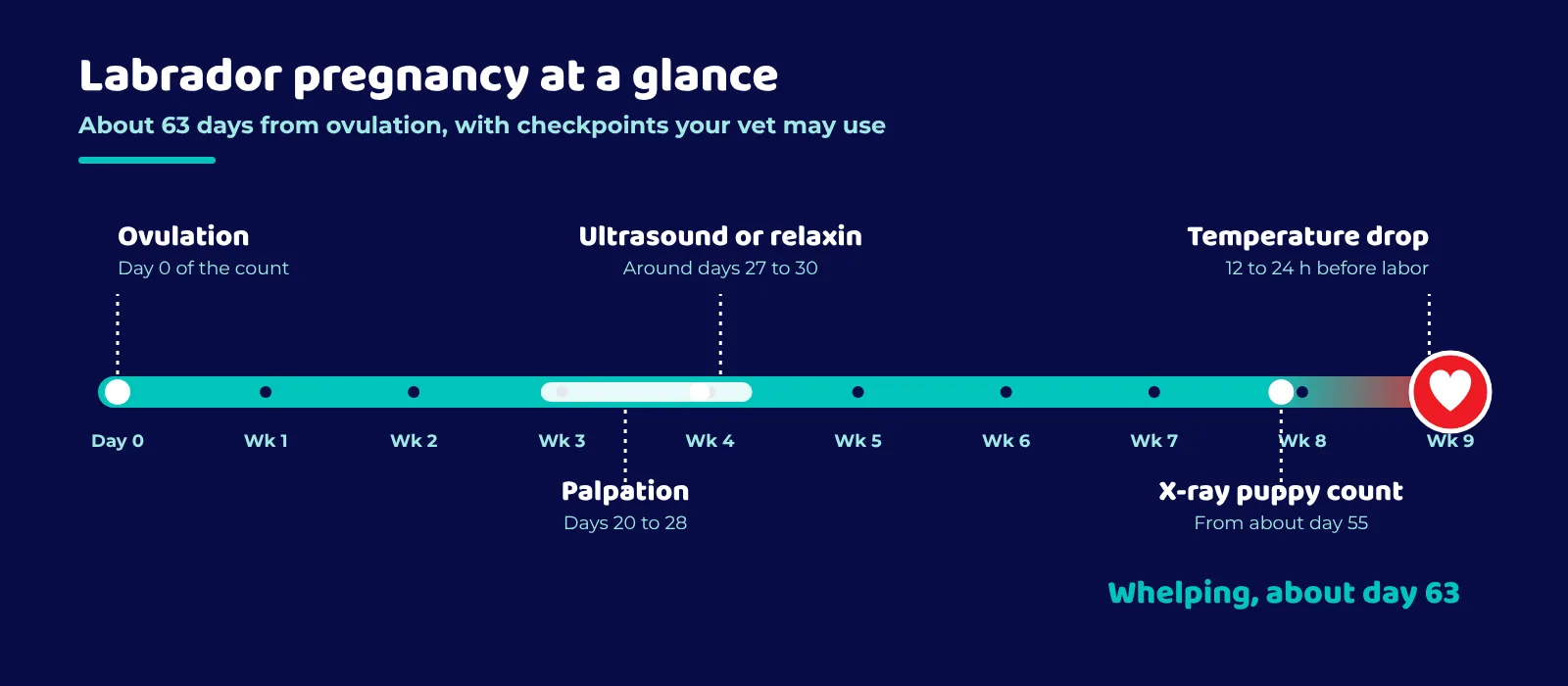
From around day 55, an X-ray lets your vet count the puppies, so you know when labor is truly finished. In the final day or so, watch her temperature: the AKC notes that a drop is expected 12 to 24 hours before labor begins.
How Many Puppies Do Labs Have?
Around seven on average, with room either side
So, how many puppies do Labs have? The AKC's litter size guide puts the average Labrador litter at seven puppies, with five to ten typical. First litters tend to be smaller, and the largest Labrador litter the AKC mentions is 15 puppies.
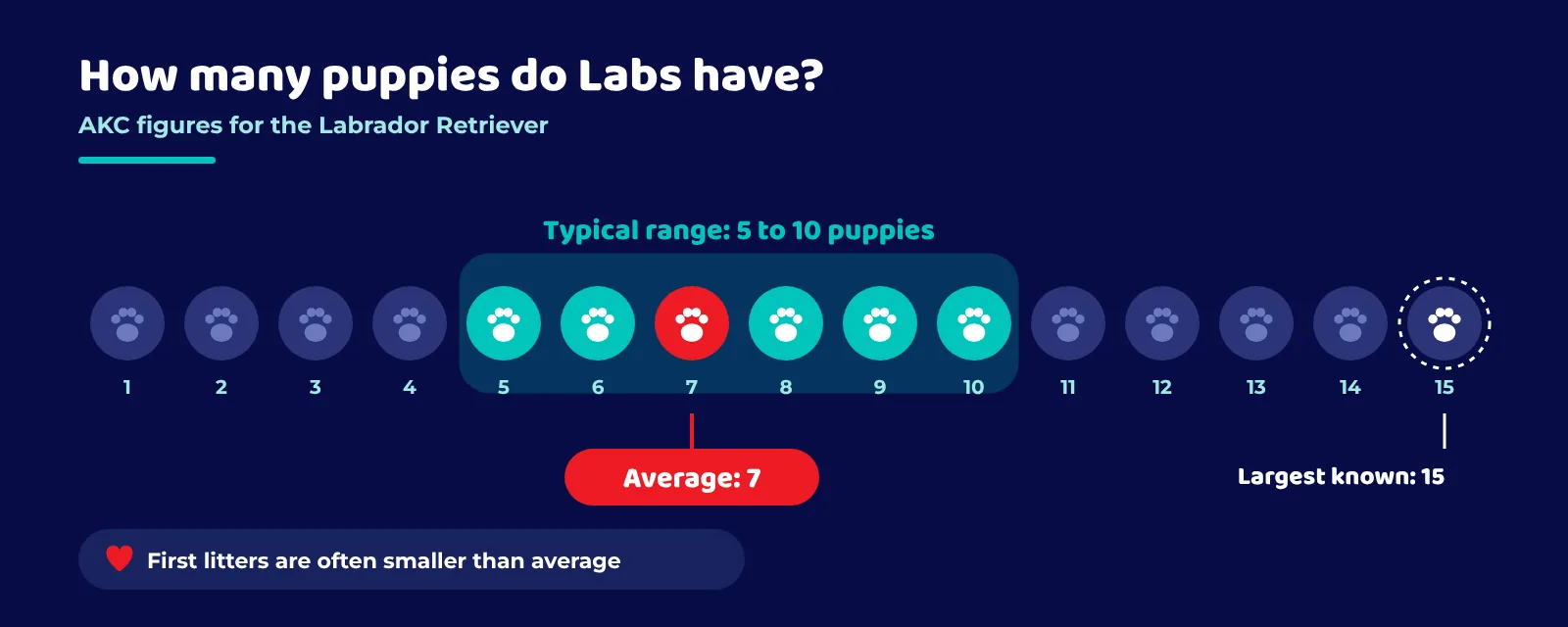
Ask how many puppies does a Labrador Retriever have in any one litter and the honest answer is that it depends on the mother. The AKC points to her size, age, health, diet and genetic diversity. If you are wondering how many puppies does a Lab have in her very first litter, plan for fewer than the average.
How many puppies can a black Lab have?
Coat color does not change the numbers. How many puppies can a black Lab have follows the same pattern as a yellow or chocolate Lab: around seven on average, five to ten typically. Litter size comes from the dam herself, not the shade of her coat.
Is a bigger litter better?
When owners ask how many puppies can a Labrador dog have, they often mean the maximum. Large litters happen, but a big number is never the goal. The better question is how many puppies can Labrador have while every pup still gets enough milk, warmth and attention. A healthy mother and puppies that all thrive matter far more than the final count.
How Labrador Coat Colors Are Inherited
Two genes decide black, chocolate or yellow
Labrador color comes down to two genes, as UC Davis veterinary experts explain. The B locus decides between black and chocolate pigment, and black is dominant. The E locus decides whether that pigment shows in the coat at all: a Lab with two copies of the recessive e is yellow, whatever its B genes say.
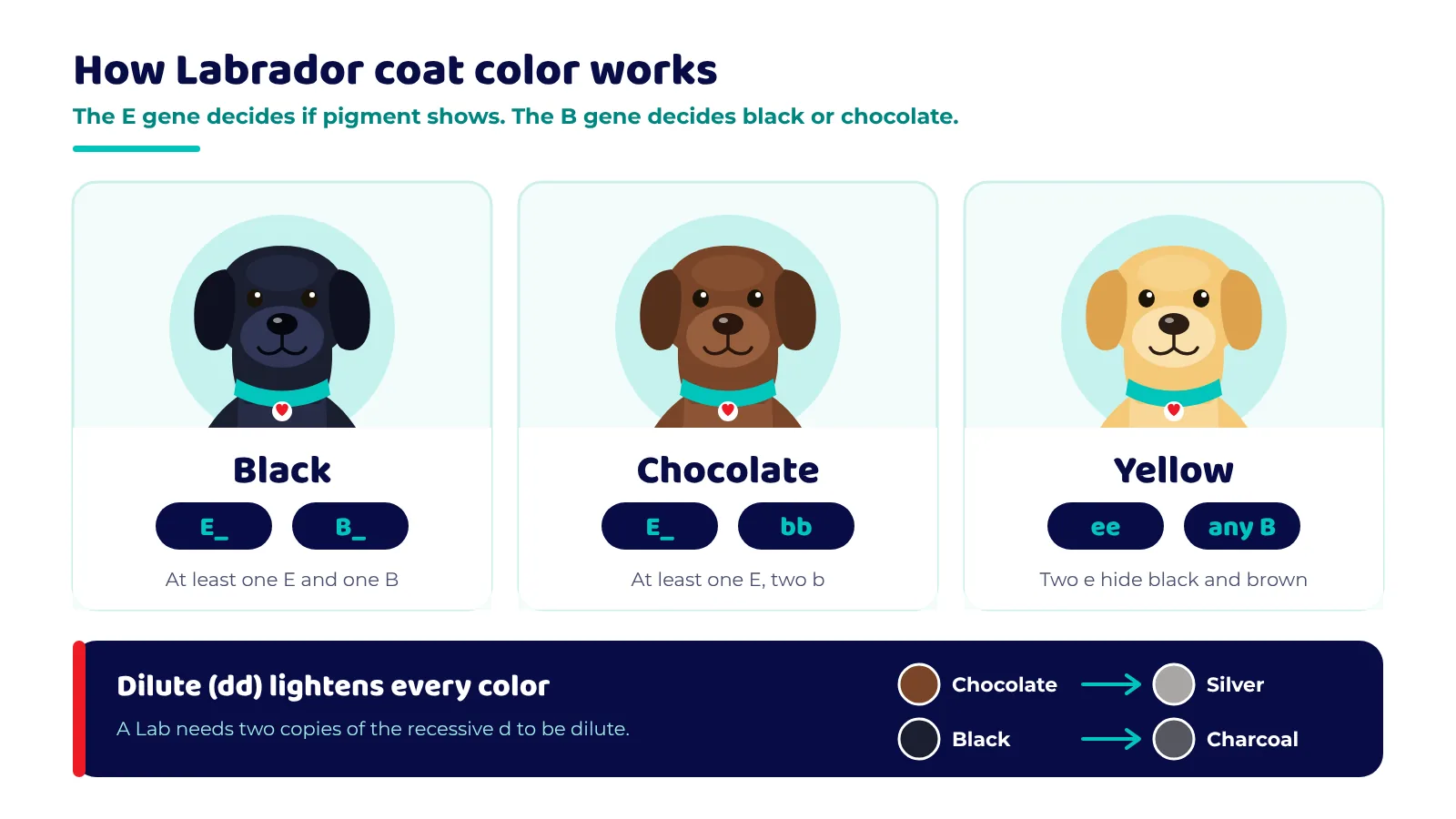
This is why two black Labs can surprise you with a yellow or chocolate puppy. If both parents quietly carry e, some puppies can be yellow. If both carry b, some can be chocolate. Two yellow Labs, on the other hand, can only produce yellow puppies, because neither parent has an E to pass on.
How to Breed a Silver Labrador, and Why It Is Debated
Know the genetics and the controversy first
If you are researching how to breed a silver Labrador, start with the genetics. Silver is not its own color gene. A silver Lab is a chocolate Lab with two copies of a recessive dilute allele at the D locus. A puppy has to inherit one dilute copy from each parent, so both parents must at least carry it. The same dilution turns black into charcoal and makes yellow look very pale.
The breed's parent club does not consider dilute an original Labrador color. An April 2026 Labrador Retriever Club committee report traced dilute dogs to modern breeding programs rather than the breed's history. It noted that dilution is linked to a skin and coat condition called color dilution alopecia in other breeds, while the risk in Labradors has not been measured in published research. It also recommended that the club consider a separate breed pathway for dilute dogs. The report is guidance for the club's board, not adopted policy, so expect this debate to keep moving.
English vs American Lab: Does Type Matter?
One breed, two different jobs
There is only one Labrador Retriever breed in the AKC. "English" and "American" describe types shaped by different goals, as Outdoor Life's breakdown explains: show lines bred toward the conformation ideal, and field lines bred for hunting drive and stamina. The labels refer to bloodlines and purpose, not where a puppy was born.
English vs American Labrador types
Trait | English (show) type | American (field) type |
|---|---|---|
Build | Stocky and thick-bodied | Taller and leaner |
Head | Broad and blocky | Narrower and finer |
Coat | Thicker | Thinner |
Energy | Calmer around the house | High drive and more energetic |
Typical breeding goal | Conformation and temperament | Field and working ability |
When you breed Lab pairs of the same type, the litter is usually more predictable. Crossing show and field lines is not wrong, but puppies may land anywhere between the two, so be upfront with families about what to expect in size and energy.
Frequently Asked Questions
Quick answers to common Lab breeding questions
How many puppies can a Lab have in her first litter?
The AKC notes that a Lab's first litter is typically smaller than average, so plan for fewer than seven. Your vet can give you an accurate count by X-ray from around day 55.
How often can a Labrador have a litter?
She comes into heat about every six months, but that is a biological rhythm, not a breeding schedule. Talk with your vet about her recovery after each litter and a sensible plan for her lifetime.
Can two yellow Labs have black puppies?
No. Yellow Labs carry two copies of e, so every puppy also inherits two copies and is yellow. A black or chocolate puppy from two yellow parents points to a parentage question worth checking with a DNA test.
Do both dogs need to be AKC registered?
Only if you want to register the puppies with the AKC. Health testing matters just as much either way, and most serious Lab owners will ask for both.
When will I know how many puppies she is carrying?
According to the AKC, an X-ray from around day 55 of pregnancy lets your vet count the puppies. Earlier ultrasound is mainly used to confirm that she is pregnant.
How do I find a Labrador stud on Petsfindly?
Create a free profile for your female, add her health results and choose Breeding Partner. You can browse dogs open to breeding and message phone-verified owners without sharing your number. Petsfindly never handles payments, so you agree terms directly with the other owner.
The Bottom Line
Patience makes healthier litters
Good Labradors breeding is never rushed. Wait until both dogs are two and fully cleared, test for brucellosis before breeding, choose a partner whose DNA results complement your dog's, and use progesterone testing so the 63-day countdown starts on the right day. Expect around seven puppies, often fewer the first time, and have a loving home lined up for every one of them.
Do it that way and you protect your Lab, her puppies and a breed that so many American families love.
Ready when your Lab is
Find your Lab's perfect match
Petsfindly helps you find a health-tested Labrador stud or breeding partner, with every match showing why it fits, from distance to the clearances each owner has shared.
- Free to browse
- Phone-verified owners
- We never take payments
Further reading
- American Kennel Club: Average litter size by breed
- American Kennel Club: How long are dogs pregnant?
- American Kennel Club: How long are dogs in heat?
- American Kennel Club: Litter registration glossary
- American Kennel Club: Brucellosis testing for breeders
- Orthopedic Foundation for Animals: Frequently asked questions
- Labrador Retriever Club: Health issues and clearances
- Labrador Retriever Club: Breeders Code of Conduct
- Labrador Retriever Club: Dilute Committee Report, April 2026
- University of Minnesota: Dynamin-1 associated exercise-induced collapse
- UC Davis: Yellow, chocolate and black Labrador Retriever puppies
- UC Davis Veterinary Genetics Laboratory: CNM in Labrador Retrievers
- Outdoor Life: English Lab vs American Lab
This guide is general information for dog owners and is not veterinary or legal advice. Talk to your veterinarian before making any breeding or health decision.