In this guide
- What makes Poodle breeding different?
- Toy vs miniature vs standard: how should you pair sizes?
- How does breeding parti poodles actually work?
- Parti, phantom or abstract: what do registries accept?
- Which health tests do poodles for breeding need?
- How do you choose the right toy poodle stud or partner?
- How does Poodle breeding work, step by step?
- How long are poodles pregnant, and how many puppies do they have?
- Poodle breeding FAQs
- The Bottom Line
Poodles look like one breed in three sizes, and that is exactly what they are. That simple fact hides most of the hard questions. Which sizes can you pair? Why did two black parents just produce a black and white puppy? Which tests does a tiny Toy actually need?
This guide answers those questions in the order a careful owner meets them. You will see how the size varieties work, how breeding parti poodles really plays out genetically, which health tests the breed club asks for, and what to expect from pregnancy and litter size. If you are new to the whole process, Petsfindly's dog breeding guide covers the basics that apply to every breed.
Key takeaways
Height decides size
A Toy is 10 inches or under at the shoulder, a Miniature is over 10 and up to 15, and a Standard is over 15.
Parti is recessive
A parti puppy needs a parti gene from both parents, which is why a DNA test beats guessing from coat color.
Tests differ by size
Toys and Minis focus on eyes and knees, while Standards add hips, thyroid and two DNA tests.
Litters follow size
AKC data puts average litters at about 3 for Toys, 5 for Minis and 7 for Standards.
What makes Poodle breeding different?
One breed, three sizes and a color palette that keeps owners guessing.
The Poodle breed standard describes three varieties, Standard, Miniature and Toy, and separates them by one measurement: height at the highest point of the shoulders. According to the Poodle Club of America breed standard, a Standard is over 15 inches, a Miniature is 15 inches or under but more than 10 inches, and a Toy is 10 inches or under.
That makes poodle breeding unusual. In most breeds, picking a partner means checking health, temperament and type. With Poodles you also need to think about size compatibility and a long list of colors and patterns, some of which are hidden in a dog's genes rather than visible in its coat.
Toy vs miniature vs standard at a glance
Variety | Height at shoulder | AKC average litter | Core health focus |
|---|---|---|---|
Toy | 10 in or under | About 3 puppies | Eyes (PRA-prcd, yearly exam) and kneecaps |
Miniature | Over 10 in, up to 15 in | About 5 puppies | Eyes, kneecaps and hips |
Standard | Over 15 in | About 7 puppies | Hips, eyes, thyroid, NEwS and vWD DNA tests |
Litter averages come from the American Kennel Club, and the health focus comes from the breed club's recommendations covered in section 05. Keep this table handy, because almost every decision below starts with "which size are we talking about?"
Toy vs miniature vs standard: how should you pair sizes?
The dam carries the litter, so her size sets the safe limits.
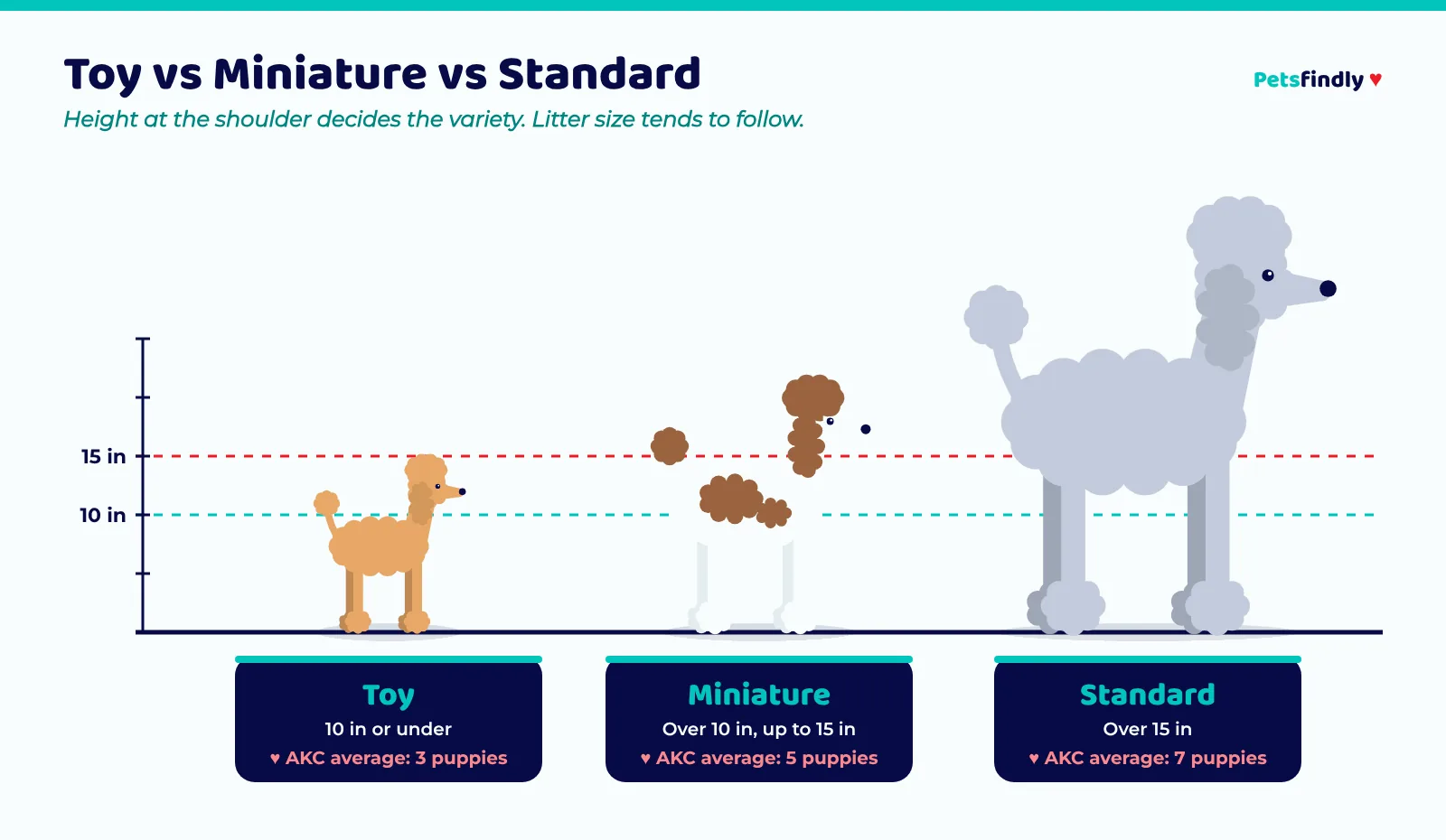
The simplest pairing is like with like: Toy to Toy, Miniature to Miniature, Standard to Standard. Puppies from same size parents are more predictable in adult size, and the dam is built to carry puppies of that size.
When sizes differ, many breeders prefer the female to be the larger of the two. The reason is practical. Puppies that are too large for the birth canal are one of the reasons some dogs need veterinary help or a C-section to deliver, a risk the AKC highlights in its notes on litter size. Ask your veterinarian to assess the dam's size and build before you agree to any cross size pairing.
Toy Poodle spotlight
Breeding toy poodles calls for extra planning because everything is small: the dam, the litter and the newborn puppies. The breed club asks Toys to have a PRA-prcd DNA test, a yearly eye exam by a veterinary ophthalmologist and a kneecap (patellar luxation) evaluation, with the exams done from one year of age. A good toy poodle stud should have all three on record before he is offered to anyone.
Miniature Poodle spotlight
Miniatures sit in the middle of the range and share the Toy's eye and kneecap concerns. The club adds a hip evaluation through OFA or PennHIP. Because the variety spans more than 10 inches up to 15, check that both partners actually measure inside it, especially if one parent came from Toy or Standard lines.
Standard Poodle spotlight
Standards are the largest variety and have the longest health checklist, including hips, eyes, thyroid and DNA tests for two inherited conditions. They also tend to have the biggest litters, so the dam needs space, support and a whelping plan that can handle more puppies at once.
How does breeding parti poodles actually work?
Parti is recessive, so the hidden carriers matter as much as the flashy coats.
A parti Poodle has a white coat with patches of another color. Genetically, parti sits at the S locus. The United Poodle Association explains that a parti dog carries two copies of the parti version of the gene, written sp/sp, and that parti is recessive. A dog with one copy (S/sp) is a carrier. Carriers can look completely solid or show small white touches on the chest, chin or feet.
That is why breeding parti poodles surprises people. Two solid looking parents can both be carriers, and each of their puppies then has a 1 in 4 chance of being parti. The odds apply to every puppy separately, so a carrier to carrier litter might have several partis or none at all.
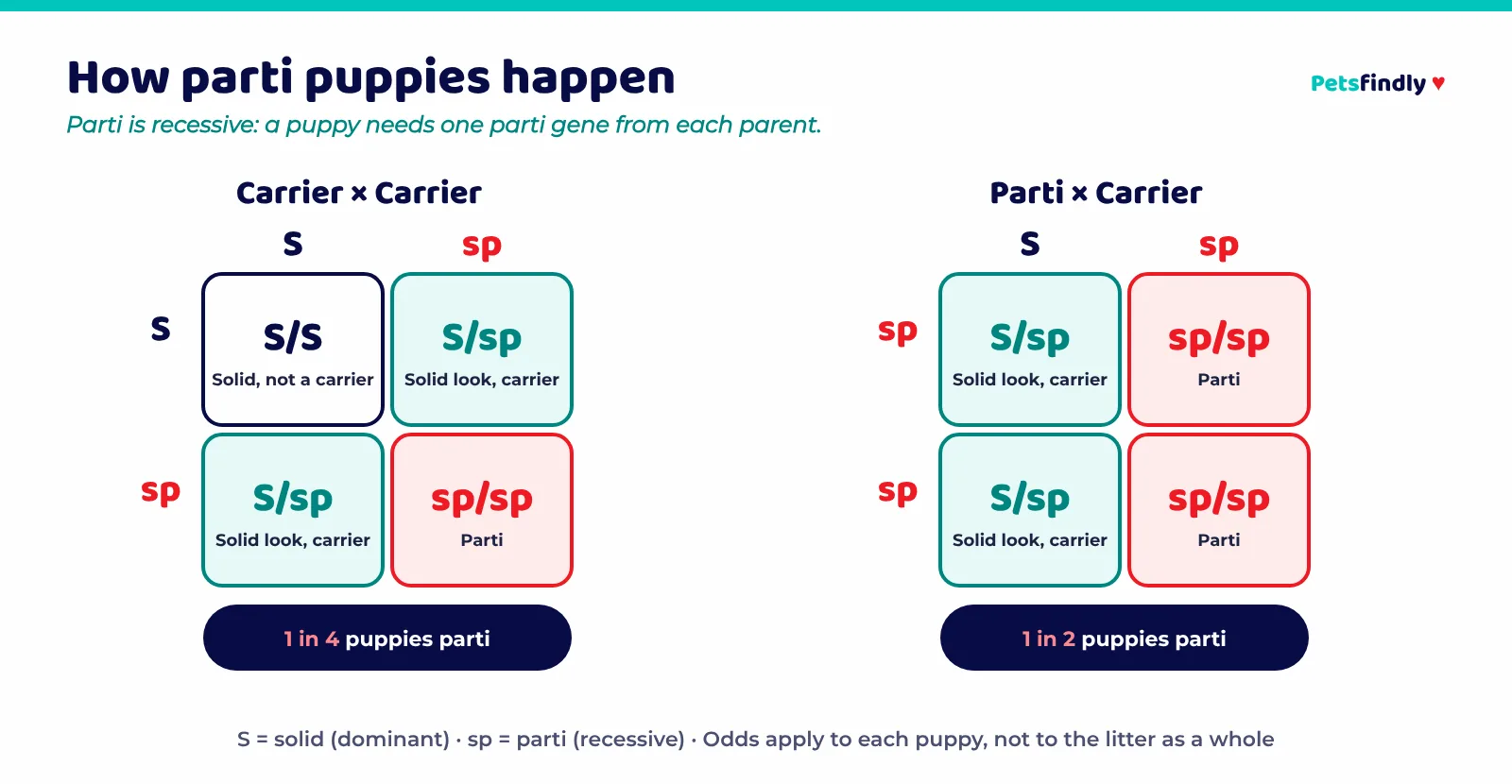
What each pairing can produce
Pairing | Chance each puppy is parti | Other puppies |
|---|---|---|
Solid non carrier x solid non carrier | None | All solid, none carry parti |
Solid non carrier x carrier | None | About half are carriers |
Solid non carrier x parti | None | All are carriers |
Carrier x carrier | 1 in 4 | About half are carriers, about a quarter are clear |
Carrier x parti | 1 in 2 | The rest are carriers |
Parti x parti | All | All carry two parti genes |
Parti, phantom or abstract: what do registries accept?
Every pattern can be a healthy pet, but the show ring is pickier.
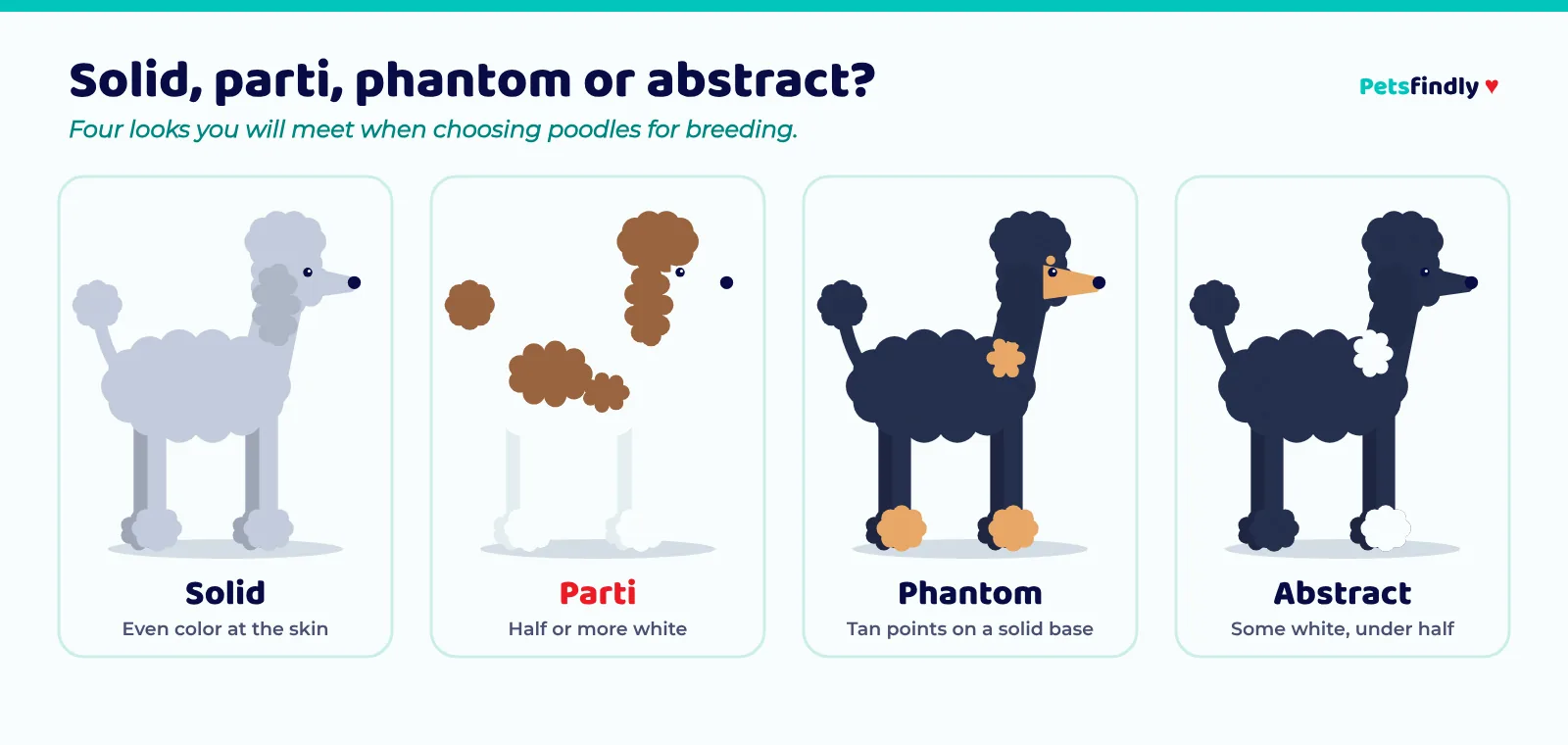
A phantom Poodle has a solid base color with tan style points above the eyes, on the muzzle, chest, legs and under the tail. The UPA describes it as a pattern at the A locus that also needs a specific K locus result, and it can be combined with parti to create a phantom parti. An abstract is a dog with some white but less than half, and the United Kennel Club multi-colored Poodle standard defines a parti as half or more white.
Registration and showing are separate questions. The AKC breed standard calls for a coat that is an even, solid color at the skin and disqualifies parti colored dogs from conformation shows. The UPA notes that AKC still registers multi-colored Poodles and that they can earn titles in other AKC events. UKC shows multi-colored Poodles, including parti, abstract and phantom, in their own division.
Which health tests do poodles for breeding need?
The breed club's list changes with size, so test for the variety you have.
The Poodle Club of America publishes a health statement listing the tests it recommends for poodles for breeding in each variety, and it asks breeders to test both the sire and the dam. The club also recommends sharing results through the Orthopedic Foundation for Animals database where applicable, so other owners can check them.
Recommended tests by variety (Poodle Club of America)
Test | Toy | Miniature | Standard |
|---|---|---|---|
PRA-prcd DNA test | Yes | Yes | Not listed |
Eye exam by a veterinary ophthalmologist | Yearly, from 1 year | Yearly, from 1 year | Yes |
Patellar luxation (kneecap) evaluation | Yes, from 1 year | Yes, from 1 year | Not listed |
Hip evaluation (OFA or PennHIP) | Not listed | Yes | Yes |
Autoimmune thyroiditis evaluation | Not listed | Not listed | Yes |
NEwS and vWD I DNA tests | Not listed | Not listed | Yes, or clear by parentage |
Heart exam and sebaceous adenitis biopsy | Not listed | Not listed | Optional |
These are the breed specific checks. Before any mating, both dogs should also be tested for canine brucellosis, a contagious bacterial disease that can cause infertility and pregnancy loss, as the AKC explains. The club's list of health concerns also mentions conditions such as Addison's disease, bloat and epilepsy, which are worth asking about even when no screening test exists.
How do you choose the right toy poodle stud or partner?
Look past the coat. The paperwork and the temperament tell the real story.
Whether you are looking for a toy poodle stud or a Standard female, the same filter applies: right size, right genetics, right health and a temperament you would be happy to see in every puppy. Use this checklist before you agree to anything.
Poodle partner checklist
Check | What good looks like | Why it matters |
|---|---|---|
Variety and height | Measured and inside the variety range | Protects the dam and keeps puppy size predictable |
Health results | Club recommended tests for that variety, viewable on request | Catches inherited problems before they reach a litter |
Brucellosis test | Recent negative result for both dogs | Protects fertility and both households |
Color genetics | S locus result if parti is a goal | Turns parti odds from a guess into a plan |
Temperament | Calm, friendly and confident with people | Puppies share their parents' nature as well as their looks |
Written agreement | Terms agreed before mating | The breed club's code of ethics asks for written contracts |
Our guide to questions to ask a stud dog owner goes deeper on conversations to have before booking. The PCA code of ethics adds a firm line many owners miss: breeders should never intentionally allow a Poodle to be bred to another breed.
How does Poodle breeding work, step by step?
Seven checkpoints from first idea to whelping box.
1Set your goals
Decide what you want to improve or preserve: size, health, temperament, color or all four. Clear goals keep the rest of the process honest and help you explain your plans to potential partners.
2Complete the health tests
Book the tests for your variety and give exams that need a minimum age time to happen. Petsfindly also explains why breeding windows are strict and which ages can appear as breeding matches.
3Check color genetics
If parti, phantom or a specific color matters to you, test both dogs first. Knowing who is a carrier lets you predict odds instead of hoping.
4Find and screen a partner
Search Poodle profiles on Petsfindly or the wider list of dogs open to breeding, then use the checklist above. Petsfindly is free to browse and members are phone verified.
5Sign a written agreement
Agree on fees, repeat breedings, puppy arrangements and registration in writing before the dogs meet. Petsfindly never handles payments, so those terms stay between the two owners.
6Time the breeding with your vet
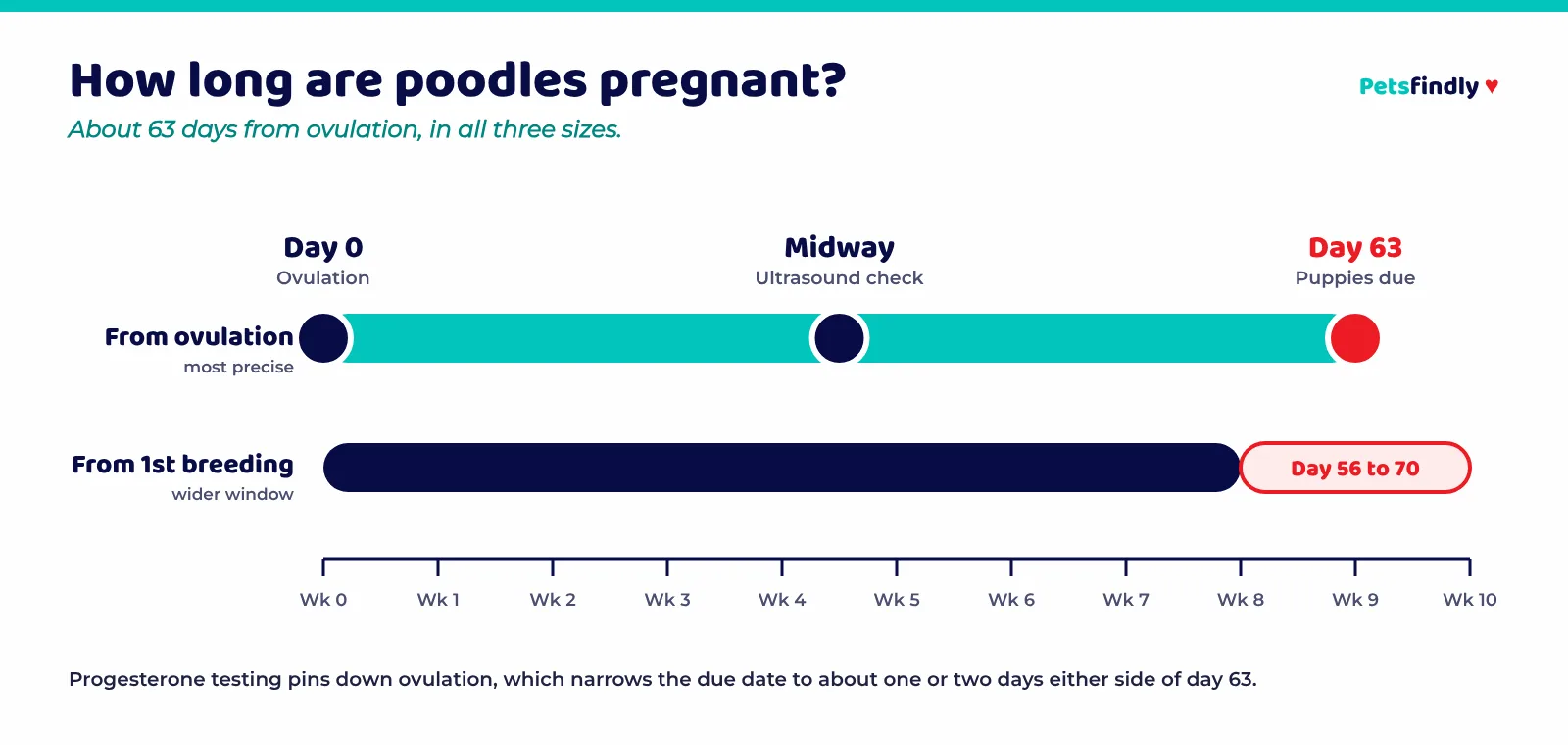
Progesterone testing helps your vet pinpoint ovulation. That improves the chance of conception and, according to Cornell University, narrows the due date to within a day or two of day 63.
7Prepare for whelping
Set up a quiet whelping area, plan vet check ins and agree on an emergency plan before the due date. Small Toy litters still need close watching, and big Standard litters need space and stamina.
How long are poodles pregnant, and how many puppies do they have?
About nine weeks, with litter size rising with body size.
If you are asking how long are poodles pregnant, the answer is the same for all three varieties. Cornell University puts canine pregnancy at an average of 63 days from ovulation. Counted from the first breeding the range is wider, about 63 days give or take seven, because sperm can survive for days and mating can happen before or after ovulation. A vet may confirm the due date with an ultrasound around the midway point.
So how many puppies do poodles have? It depends heavily on size. The AKC reports an average litter of 5 to 6 puppies across all dogs, with a normal range of 1 to 12, and notes that bigger dogs can carry more puppies safely. First litters can be smaller, and age, health and genetic diversity all play a part.
How many puppies can a toy poodle have?
AKC data puts the average Toy Poodle litter at about 3 puppies. Owners often ask how many puppies can a toy poodle have or how many puppies does a toy poodle have hoping for a single number, but each litter varies. Plan and budget for the average, and let your vet's checks guide you closer to the due date.
How many puppies can a miniature poodle have?
The AKC average for Miniatures is about 5 puppies. That is the honest answer to how many puppies do mini poodles have, how many puppies can a miniature poodle have and how many puppies do miniature poodles have: around five, with real litters landing above or below.
How many puppies can a standard poodle have?
Standards average about 7 puppies according to the AKC. When people ask how many puppies can a poodle have, this is usually the variety pushing the top of the range, so a Standard dam needs a whelping area and a support plan sized for a busy litter.
Poodle breeding FAQs
Quick answers to the questions owners ask most.
Can two solid Poodles have parti puppies?
Yes. If both parents carry one parti gene, each puppy has a 1 in 4 chance of being parti. An S locus DNA test shows which solid dogs are carriers.
Can parti Poodles be AKC registered?
Yes. According to the United Poodle Association, AKC registers multi-colored Poodles, but parti colored dogs are disqualified from AKC conformation shows. They can still compete in other AKC events, and UKC shows them in a multi-colored division.
How many puppies can a poodle have?
AKC averages are about 3 for Toys, 5 for Miniatures and 7 for Standards. Any single litter can be smaller or larger, and first litters can be smaller.
How long are poodles pregnant?
About 63 days from ovulation in all three varieties. Counted from the first breeding, puppies usually arrive somewhere around day 56 to day 70.
Can you breed a Toy Poodle with a Miniature Poodle?
It happens, but size matters more than labels. Many breeders prefer the female to be the larger partner, and your vet should assess the dam before any cross size pairing.
What tests should a toy poodle stud have?
The breed club lists a PRA-prcd DNA test, a yearly eye exam by a veterinary ophthalmologist and a kneecap evaluation, plus a negative brucellosis test before each breeding.
The Bottom Line
Size first, genetics second, health always.
Great poodles breeding plans are rarely about luck. Match sizes so the dam stays safe, test color genetics so parti puppies are a plan rather than a surprise, and finish the breed club's health tests for your variety before you shake hands on anything.
Do that, and breeding parti poodles or any other Poodle pairing becomes a series of informed choices. The puppies get healthier parents, the owners get fewer surprises, and the breed gets a little better with every litter.
Size and color, sorted
Find your Poodle's perfect match
Create a free profile, share your Poodle's size, color and health results, and connect with phone-verified owners looking for the same things you are.
- Free to browse
- Phone-verified owners
- We never take payments
Further reading
- Poodle Club of America: AKC Poodle breed standard
- Poodle Club of America: Health statement for AKC (December 2024)
- Poodle Club of America: Health concerns
- Poodle Club of America: Code of ethics
- American Kennel Club: Average litter size
- American Kennel Club: Brucellosis testing for breeders
- Cornell Riney Canine Health Center: The normal whelping process
- UC Davis Veterinary Genetics Laboratory: Piebald / white spotting (S locus)
- United Poodle Association: Poodle colors
- United Kennel Club: Multi-colored Poodle standard
This guide is general information for Poodle owners and is not veterinary or legal advice. Talk to your veterinarian before making any breeding or health decision.