
In this guide
- What Counts as a Successful Dog Mating?
- What Are the Signs That a Male Dog Wants to Mate?
- When Is the Best Mating Time for Dogs?
- How Long Does It Take a Dog to Mate?
- What Are the Signs a Female Dog Has Mated?
- What Are the Signs a Male Dog Has Mated?
- How Do Vets Confirm a Dog Pregnancy?
- Repeat Mating and What Happens Next
- Dog Mating FAQs
- The Bottom Line
You saw the dogs together. Maybe you even saw them tied. Now you are watching your female and wondering one thing: did it work?
It is the most common question after any breeding, and the honest answer has two parts. Some signs tell you a mating happened. Different signs, weeks later, tell you whether it produced puppies. Mixing those two up is where most of the stress (and the wishful thinking) comes from.
This guide walks through both. You will learn the signs that a male dog wants to mate, the best mating time for dogs, what a normal mating looks like from greeting to separation, the signs a female dog has mated, and how vets confirm a pregnancy. If you are still choosing a partner, start with Petsfindly's dog breeding guide.
Key takeaways
The tie is the tell
A copulatory tie is the clearest sign mating happened, though pregnancy can occur without one.
Timing beats instinct
Progesterone testing pinpoints her fertile days far better than counting days of heat.
Never pull them apart
Keep both dogs calm and steady during a tie and let it end on its own.
Confirm with a vet
A relaxin test or ultrasound from about 3 to 4 weeks after breeding gives you a real answer.
What Counts as a Successful Dog Mating?
Mating and pregnancy are two different finish lines
People use "successful mating" to mean two different things. The first is a completed breeding: the male mounted, the dogs tied and semen was delivered. The second is a pregnancy. A completed mating is something you can watch. A pregnancy is something only time and a vet can confirm.
That gap exists because the female's body makes the final call. Healthy sperm can live 5 to 11 days inside her reproductive tract, according to the American Kennel Club, so conception may happen days after the dogs were together. On the other hand, a textbook tie on the wrong day of her cycle can produce no puppies at all. When you look for signs of successful mating in dogs, keep both finish lines in mind.
What each sign really tells you
Sign you notice | What it tells you | What it does not tell you |
|---|---|---|
Copulatory tie | Mating happened and semen was very likely delivered | Whether her eggs were ready to be fertilized |
Damp or matted fur around her rear | Recent mating contact | Whether a full tie took place |
She stops accepting males a few days later | Her fertile phase is ending | Whether she is pregnant, since this happens bred or not |
Appetite or mood changes weeks later | Hormones are shifting after heat | Pregnancy, since false pregnancy causes the same signs |
Positive relaxin test or ultrasound | She is pregnant | Exact litter size, which X-rays near term show best |
What Are the Signs That a Male Dog Wants to Mate?
His nose knows long before you do
Male dogs find a female in heat by scent. PetMD explains that pheromones in her urine and discharge signal that she is fertile and can trigger mating behavior, and that intact males can breed at any time of year once they pick up that signal. The signs that a male dog wants to mate usually build as she moves from early heat toward her fertile days.
Fertility arrives early in males. The AKC notes they can be capable of reproducing from about 5 months old and tend to be most fertile once fully mature, between 12 and 15 months, with rising testosterone often bringing more marking and roaming. Able to mate is not the same as ready to mate, though. Maturity and health testing still come first, which is why Petsfindly explains why breeding windows are strict on purpose.
Common signs a male dog is interested in mating
Behavior | What it looks like | What to do |
|---|---|---|
Intense sniffing and licking | Nose glued to her rear or to spots where she urinated | Normal courtship. Supervise closely |
Mounting attempts | Repeated mounting, sometimes from the side or the wrong end | Let an experienced handler steady both dogs |
Restlessness and whining | Pacing, crying at doors or fences, trouble settling | Keep him securely apart until the agreed date |
More frequent marking | Lifting his leg more often, especially where she has been | Expect it and clean marked spots well |
Escape attempts | Digging, jumping or slipping a leash to reach her | Double check gates, crates and collars |
Skipped meals | Losing interest in food while she is nearby | Usually passes. Call your vet if it continues |
When Is the Best Mating Time for Dogs?
Her cycle sets the clock, not his enthusiasm
A male may be keen on every day of her heat, but she is only receptive for part of it. Cornell's Riney Canine Health Center describes proestrus as lasting about 6 to 11 days on average, a stage when she attracts males but will not stand for them. Estrus, her fertile stage, usually lasts 5 to 9 days but can range from 1 to 20. Most dogs come into heat about twice a year.
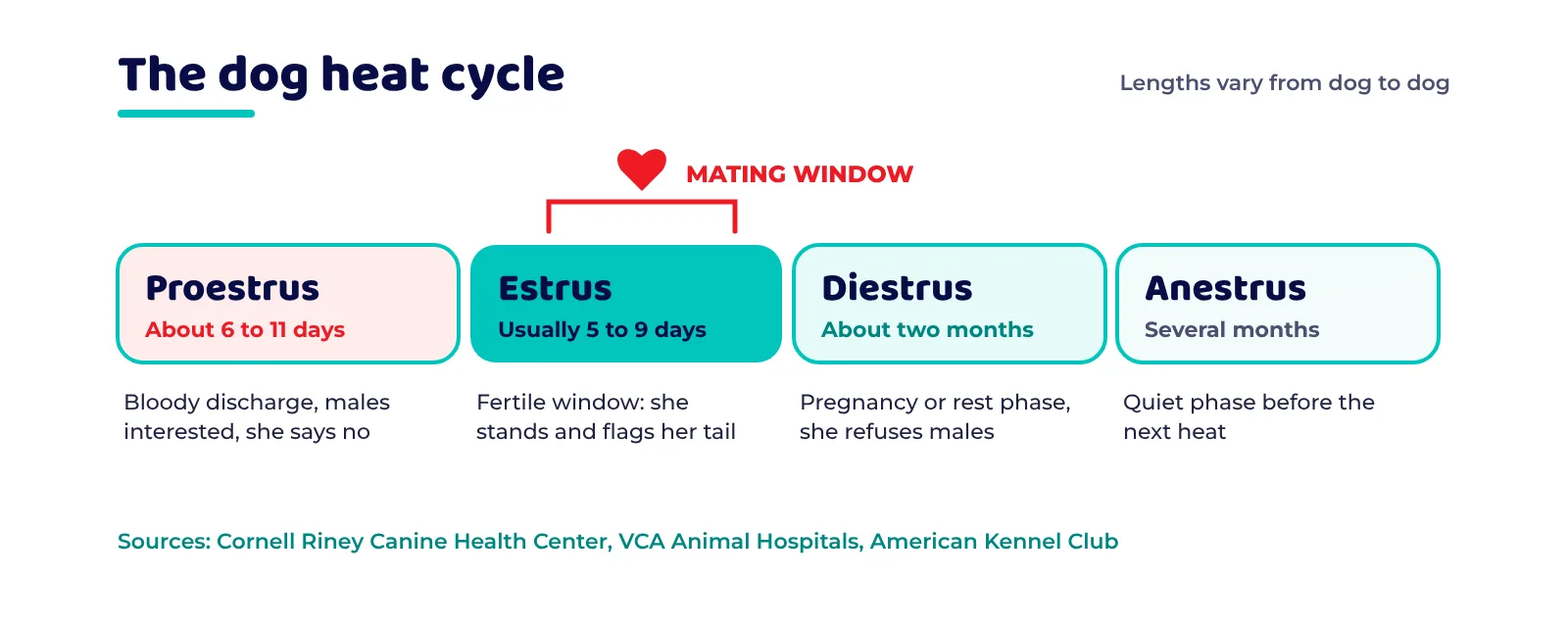
The four stages of the heat cycle
Stage | Typical length | What you will notice | Will she mate? |
|---|---|---|---|
Proestrus | About 6 to 11 days | Swollen vulva, bloody discharge, sudden male interest | Usually not. She may flirt but refuse mounting |
Estrus | Usually 5 to 9 days | Discharge turns lighter, she stands and moves her tail aside | Yes. This is the fertile window |
Diestrus | About two months | Swelling fades and she turns males away | No |
Anestrus | Several months | A quiet rest phase before the next heat | No |
The classic rule of thumb from VCA Animal Hospitals puts the best mating time for dogs between the 10th and 14th day of heat. VCA also points out that some females ovulate as early as day 3 or 4 and others as late as day 18, which is why breeders lean on progesterone blood tests. The AKC suggests a baseline sample 7 to 10 days after the first signs of heat, then testing every other day once levels start to climb. A female is generally thought to be ovulating when progesterone reaches about 5 to 10 ng/mL.
How Long Does It Take a Dog to Mate?
From first sniff to separation, step by step
If you are asking how long does it take a dog to mate, the answer depends mostly on experience. A confident, experienced pair can go from greeting to tie in a few minutes. Nervous first timers may need more time or a second session. VCA notes that male dogs tend to be more stress sensitive than females during mating, so a calm, familiar setting helps. The tie itself is usually the longest single stage.
1Greeting and courtship
The dogs sniff, play bow and circle each other. A receptive female will stand still and move her tail to one side. If she sits down or snaps every time he tries, she may simply not be at her fertile point yet.
2Mounting
The male mounts from behind and grips her flanks with his front legs. It can take several tries to get the angle right, especially with a big size difference, so a handler often steadies the female at her head.
3The turn
Once he is in, swelling at the base of his penis holds the pair together. The male then usually lifts one hind leg over her back, or is gently turned by a handler, so the dogs end up standing rear to rear.
4The copulatory tie
This is the lock. VCA says the tie usually lasts 5 to 10 minutes, and some run longer. Semen is delivered during this phase, so both dogs should stay quiet, standing and supported.
5Natural separation
The swelling eases and the dogs come apart on their own. Both usually lick themselves clean, then want water and a rest.
Put together, the total mating time for dogs is usually counted in minutes, not hours. Just do not judge success by the clock. VCA notes that pregnancy can occur without a tie at all, which breeders call a slip mating.
How long the tie lasts, and what to do during it
The copulatory tie startles a lot of first time owners. The dogs look stuck, and one of them may whine or try to walk off. That is normal canine anatomy, not an emergency. Your only job is to keep both dogs calm and make sure neither one can drag the other.
What Are the Signs a Female Dog Has Mated?
Clues in the first hours, and the ones that fool people
If you did not see the breeding, or you suspect an unplanned one, the signs a female dog has mated are subtle. None of them is proof on its own. Together, they tell a story.
Right after mating
Look for damp or matted fur around her vulva and the backs of her hind legs, extra licking of the area, and a dog who seems tired, thirsty or unusually clingy. Her vulva may look a little more swollen for a short while. She is still in heat, so some discharge is expected, but heavy bleeding, straining or obvious pain is a reason to call your vet.
In the days that follow
The signs that a female dog has mated in heat are easy to confuse with the normal end of her cycle. Within days she will stop flirting and start turning males away. The AKC explains that once she reaches diestrus she no longer permits mating, and that happens whether she was bred or not. A sudden change in attitude tells you about her calendar, not about puppies.
Weeks later
Bigger appetite, weight gain, larger nipples and nesting are classic pregnancy signs listed by the AKC. The catch is that false pregnancy produces almost the same list. The AKC says it shows up about two months after heat and can affect females whether they were bred or not.
What Are the Signs a Male Dog Has Mated?
He mostly tells you by cleaning up and calming down
The signs a male dog has mated are usually easier to read than hers. After a tie he will typically spend a while licking his genital area. His penis may stay partly exposed for a short time before sliding back into the sheath, and his frantic interest in the female often softens for a few hours while he drinks and rests.
That calm does not last long if she is still in her fertile window, which is why stud owners plan any repeat mating around her progesterone results instead of his mood. If a male has several breedings with no litters, a breeding soundness exam with a semen evaluation, described in the Merck Veterinary Manual, is the sensible next step.
How Do Vets Confirm a Dog Pregnancy?
The tests, the timing and the dates to circle
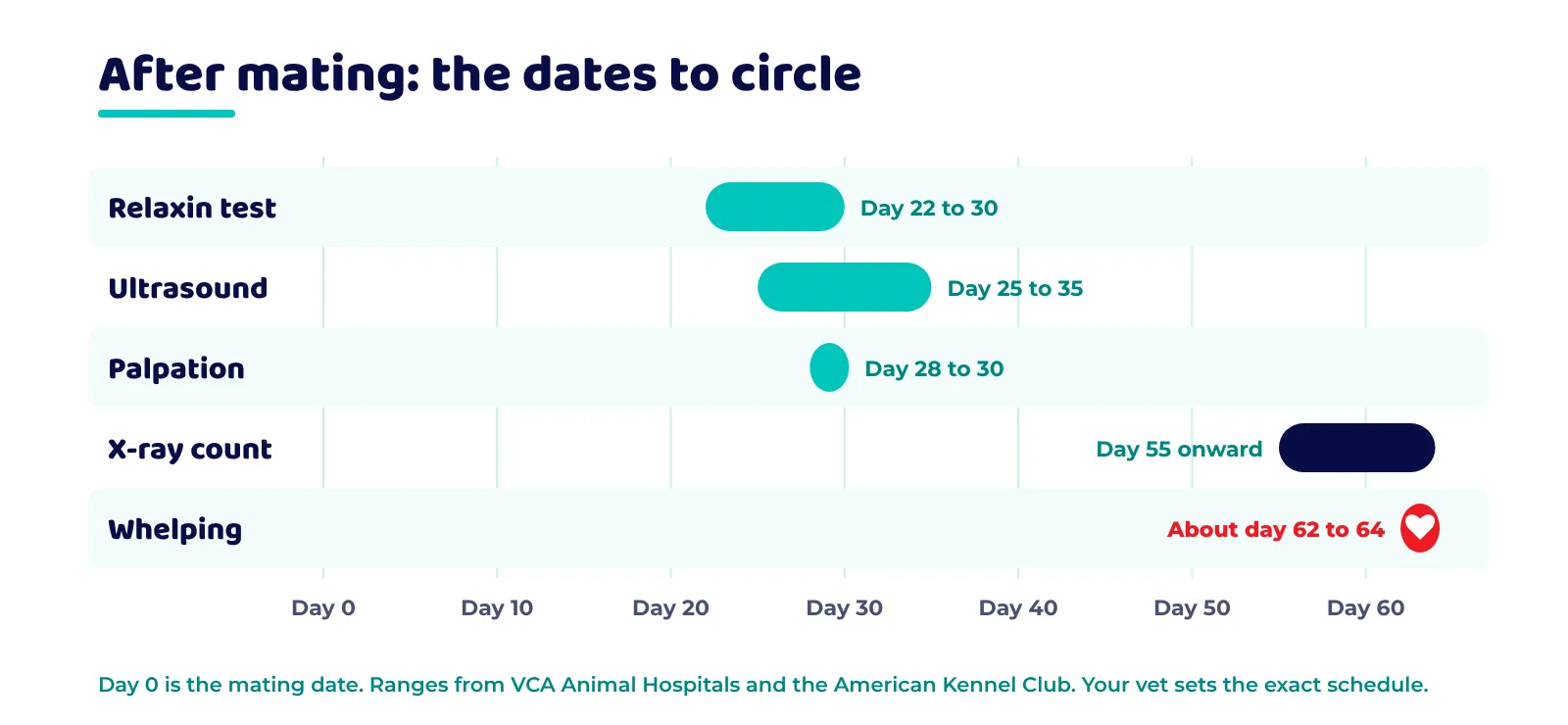
Even the clearest signs of successful mating in dogs only tell you a breeding happened. Confirming pregnancy takes a vet visit, and timing matters because each test has its own window.
Dog pregnancy tests and when they work
Test | Earliest useful timing | What it tells you | Good to know |
|---|---|---|---|
Relaxin blood test | About 22 to 30 days after breeding | Pregnant or not | VCA advises repeating a negative result about a week later |
Ultrasound | From about 3 weeks, most often 25 to 35 days | Pregnancy and puppy heartbeats | VCA calls it the gold standard |
Abdominal palpation | Around 28 to 30 days | A likely pregnancy | Accuracy depends on the dog and the examiner |
X-ray | Day 55 or later | How many puppies to expect | The best way to count puppies before whelping |
The ranges above come from VCA and the AKC. Dogs are pregnant for approximately 62 to 64 days, according to the AKC. Because sperm can survive for days and ovulation varies, the Merck Veterinary Manual notes that breeding dates predict whelping less closely than ovulation does, one more reason to keep those progesterone results.
Repeat Mating and What Happens Next
The days after breeding, and the weeks that follow
Should you plan a repeat mating?
VCA says it is normal to arrange two matings, often 24 to 48 hours apart, and the Merck Veterinary Manual notes that stud owners commonly allow a limited number of breedings, usually two, timed to her progesterone results. Agree on this in writing before the first mating so nobody is negotiating in the middle of her heat.
Caring for her after mating
Keep her away from other intact males until her heat has fully ended, since she may still accept a mate for several days. There is no need to change her food right away. The AKC says diet usually stays the same for the first two thirds of pregnancy, then rises gradually in the final weeks to 35 to 50 percent more than usual, following your vet's advice.
Spotlight: Bulldogs, French Bulldogs and Boston Terriers
Breeds with a large head and a narrow pelvis often struggle to whelp naturally. The AKC names Bulldogs, French Bulldogs and Boston Terriers among them and says a planned C-section may be preferable. Talk through a whelping plan with your vet as soon as pregnancy is confirmed.
Spotlight: first time studs and maiden females
Inexperienced dogs do best in a quiet, familiar space with a patient handler. Because males tend to be more stress sensitive during mating, many breeders bring the female to the male's home and give the pair time to get comfortable before expecting a tie.
Spotlight: long distance pairs
When dogs live too far apart, breeders often use artificial insemination with chilled or frozen semen, performed by a vet. The timing shifts too. Merck lists chilled semen breedings on days 4 and 6 or 3 and 5 after the first progesterone rise, and frozen semen on day 5 or 6. The AKC also has DNA requirements for litters from fresh extended or frozen semen.
Dog Mating FAQs
Quick answers to the questions owners ask most
How long does it take a dog to mate?
Courtship can take a few minutes for experienced dogs or longer for first timers. The tie that follows usually lasts 5 to 10 minutes, so how long does it take a dog to mate is usually answered in minutes rather than hours.
Can a dog get pregnant without a tie?
Yes. VCA notes that pregnancy can occur without a tie. A tie makes delivery of semen more likely, but its absence does not rule out puppies.
How many times should dogs mate?
Many breeders plan two matings, often 24 to 48 hours apart, timed to the female's progesterone results. Agree on the number with the stud owner in writing beforehand.
How soon can I confirm my dog is pregnant?
A relaxin blood test can work from about 22 to 30 days after breeding, and an ultrasound is most often done between 25 and 35 days. An X-ray from day 55 counts puppies.
Is it normal for a female to bleed after mating?
She is still in heat, so some discharge is normal. Heavy bleeding, straining, swelling that worsens or obvious pain needs a call to your vet.
Why does my male dog lose interest after mating?
A short calm spell after a tie is normal. His interest usually returns while she is still fertile, which is why a repeat mating can be scheduled a day or two later.
The Bottom Line
See the tie, trust the tests
Successful dog mating has a look: a willing female, a focused male, a copulatory tie and two tired dogs afterward. The real answer, though, arrives weeks later on an ultrasound screen or a relaxin test.
Time the breeding with progesterone tests, let the tie end on its own, log every date and book the confirmation visit for around week four. Do that and you will spend less time guessing and more time getting ready for puppies.
Planning a litter?
Find a health-tested breeding partner
List your dog free, share the health results you have and keep every mating date in your owner dashboard.
- Free to browse
- Phone-verified owners
- We never take payments
Further reading
- VCA Animal Hospitals: Estrus and mating in dogs
- VCA Animal Hospitals: Pregnancy testing in the dog
- American Kennel Club: The reproductive cycle in dogs
- American Kennel Club: Dog pregnancy signs and care
- American Kennel Club: Progesterone testing in dogs
- American Kennel Club: Signs of false pregnancy in dogs
- Cornell Riney Canine Health Center: Dog estrous cycles
- Merck Veterinary Manual: Breeding management of bitches
- Merck Veterinary Manual: Paraphimosis in dogs and cats
- PetMD: Dog in heat
This guide is general information for dog owners and is not veterinary advice. Talk to your veterinarian before any breeding or health decision, and check local rules that apply to breeding in your area.