
In this guide
- When Is a Female Dog Ready to Mate?
- Is There a Mating Season for Dogs?
- The Dogs Mating Cycle, Stage by Stage
- Signs She Is in Standing Heat
- When Is a Dog Fertile? The Progesterone Timeline
- When to Breed a Dog in Heat: A 5 Step Timing Plan
- Fresh, Chilled or Frozen: How the Window Changes
- Split Heats, Silent Heats and Breed Differences
- Frequently Asked Questions
- The Bottom Line
Most missed litters are not caused by a bad stud or a bad female. They are caused by a calendar. An owner counts to day 11, books the stud, makes the drive, and finds out a few weeks later that ovulation happened days earlier or days later than the "rule" promised.
If you are asking when is a female dog ready to mate, the honest answer is that her hormones decide, and your job is to read them. This guide walks through every stage of the dogs mating cycle, the signs that matter, the progesterone numbers vets use, and a simple plan for booking the right days. If you have not picked a partner yet, Petsfindly's Stud My Dog guide covers that side of the match.
Key takeaways
No fixed day
Heat stages range from about 3 to 21 days, so day counting alone often misses the window.
Signs point, tests prove
Flagging and lighter discharge suggest estrus. Progesterone testing confirms ovulation.
Days 4 to 6
The best breeding days usually fall 4 to 6 days after the LH surge.
Maturity first
Most responsible breeders wait until a female is about two and fully health tested.
When Is a Female Dog Ready to Mate?
Two clocks have to line up: her age and her cycle
People usually mean one of two things by this question. The first is age: is she old enough to carry a litter safely? The second is timing: which days in this heat will actually produce puppies? Both need a yes before you book a stud.
Ready by age
A female can come into heat as young as 6 months, but being able to conceive is not the same as being ready. The American Kennel Club describes 2 years of age as a minimally appropriate age for breeding and notes that females are generally most fertile, with the lowest risk, between about 2 and 4 years old. Waiting also gives time for hip, elbow and other breed screenings to be finalized. So when can dogs mate responsibly? After her body has finished growing and her health results are in hand, not at her first heat.
Petsfindly takes the same careful line in matching, and explains why in why breeding windows are strict on purpose.
Ready by cycle
Within a heat, she is ready during estrus, the receptive stage, and most fertile a few days after ovulation. That is the part of the answer this guide spends the most time on, because it is where most breedings succeed or fail.
Is There a Mating Season for Dogs?
Short version: not for most breeds
Owners often ask when is mating season for dogs, expecting a spring answer like deer or birds. For most breeds there is no mating season for dogs at all. VCA Animal Hospitals notes that dogs have no set breeding season, apart from Basenjis and some sled dog breeds, which typically cycle in spring. Everyone else follows her own rhythm, at any time of year.
That rhythm is her heat frequency. The AKC says most dogs come into heat roughly every seven months, and VCA describes it as about twice a year, with small breeds sometimes cycling three times a year and giant breeds sometimes only once. So the real answer to when is the mating season for dogs is simple: whenever your female's next heat lands.
First heat and heat frequency by size
Dog type | Typical first heat | How often she cycles | What it means for you |
|---|---|---|---|
Small and toy breeds | By about 6 to 7 months | About twice a year, sometimes three times | Short gaps between heats, so plan early |
Medium breeds | About 7 to 9 months | Roughly every seven months | The classic twice a year pattern |
Large breeds | About 12 to 16 months | Roughly every seven months | First cycles may be irregular |
Giant breeds | Can be 18 months to 2 years | Sometimes only once a year | Long waits if you miss a window |
Basenji and Tibetan Mastiff | Varies | Once a year | A true seasonal pattern, often in spring for Basenjis |
The Dogs Mating Cycle, Stage by Stage
Four stages, and only one of them is the green light
The dogs mating cycle has four stages. Proestrus and estrus together make up what most owners call "heat." The AKC notes that each averages about nine days but can run anywhere from about 3 to 21 days, which is exactly why fixed day counts fail.
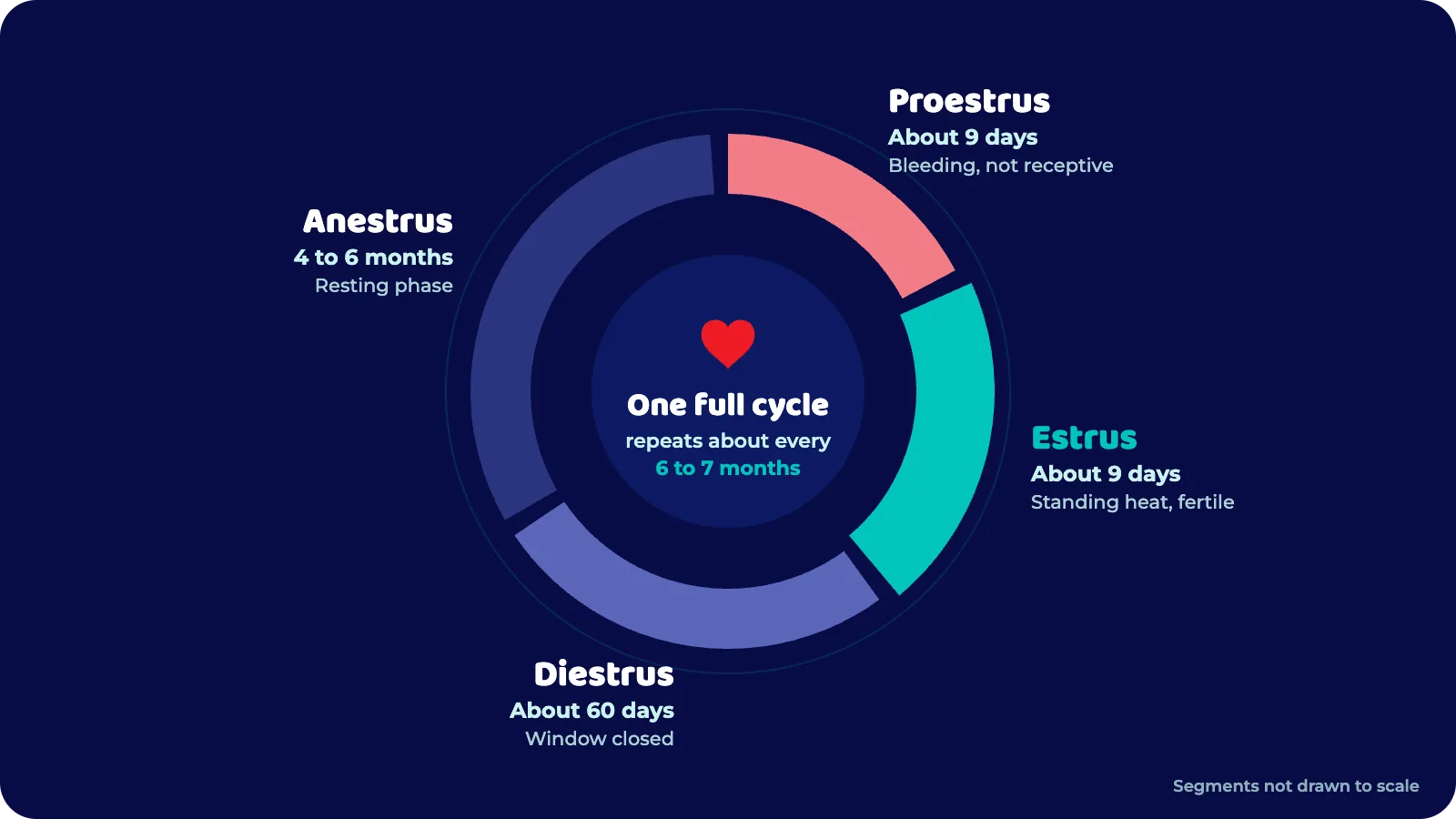
The four stages of the dogs mating cycle
Stage | Typical length | What you see | Will she mate? |
|---|---|---|---|
Proestrus | Average about 9 days, range about 3 to 21 | Swollen vulva, bloody discharge, males suddenly interested | No. She attracts males but usually refuses them |
Estrus | Average about 9 days, range about 3 to 21 | Lighter pinkish or straw colored discharge, flagging, standing | Yes. This is standing heat and the fertile stage |
Diestrus | About 60 days | Swelling and discharge fade, males lose interest | No. The fertile window has closed |
Anestrus | About 4 to 6 months | No outward signs | No. This is the resting phase |
Signs She Is in Standing Heat
What her body says, and where it can fool you
The shift from proestrus to estrus usually shows up in three places. Watch all of them, because no single sign is reliable on its own.
Discharge color
Early heat discharge is bloody red. As she moves into estrus, the AKC says it typically lessens and changes to pinkish or yellowish, and VCA describes it as thinner and more watery. That change in discharge color is one of the clearest outward hints that her fertile stage is starting.
Flagging
Flagging is when she moves her tail to one side, especially when her back end is touched or a male is near. Many breeders do a gentle check by scratching just above the tail base and watching whether the tail swings away.
Standing for the male
In proestrus she flirts, then snaps or sits down. In standing heat she plants her feet, lifts her back end slightly and holds still. Other common behavior changes include more frequent urination, extra licking, restlessness and a weaker recall when she is focused on finding a mate.
When Is a Dog Fertile? The Progesterone Timeline
The numbers vets use to find the real window
So when is a dog fertile, exactly? The answer comes from progesterone timing. Progesterone stays low through most of proestrus, then begins to climb right before ovulation. Tracking that climb with blood tests lets your vet find two key moments: the LH surge and ovulation.
According to the University of Missouri Veterinary Medical Diagnostic Laboratory, the LH surge usually happens on the day progesterone first rises above about 2 ng/mL, and ovulation usually follows when progesterone exceeds about 5 ng/mL. Dog eggs are released immature. They need roughly two more days before they can be fertilized, and then they stay viable for about 3 to 4 days. That puts the best breeding days at about 4 to 6 days after the LH surge, or 2 to 4 days after ovulation.
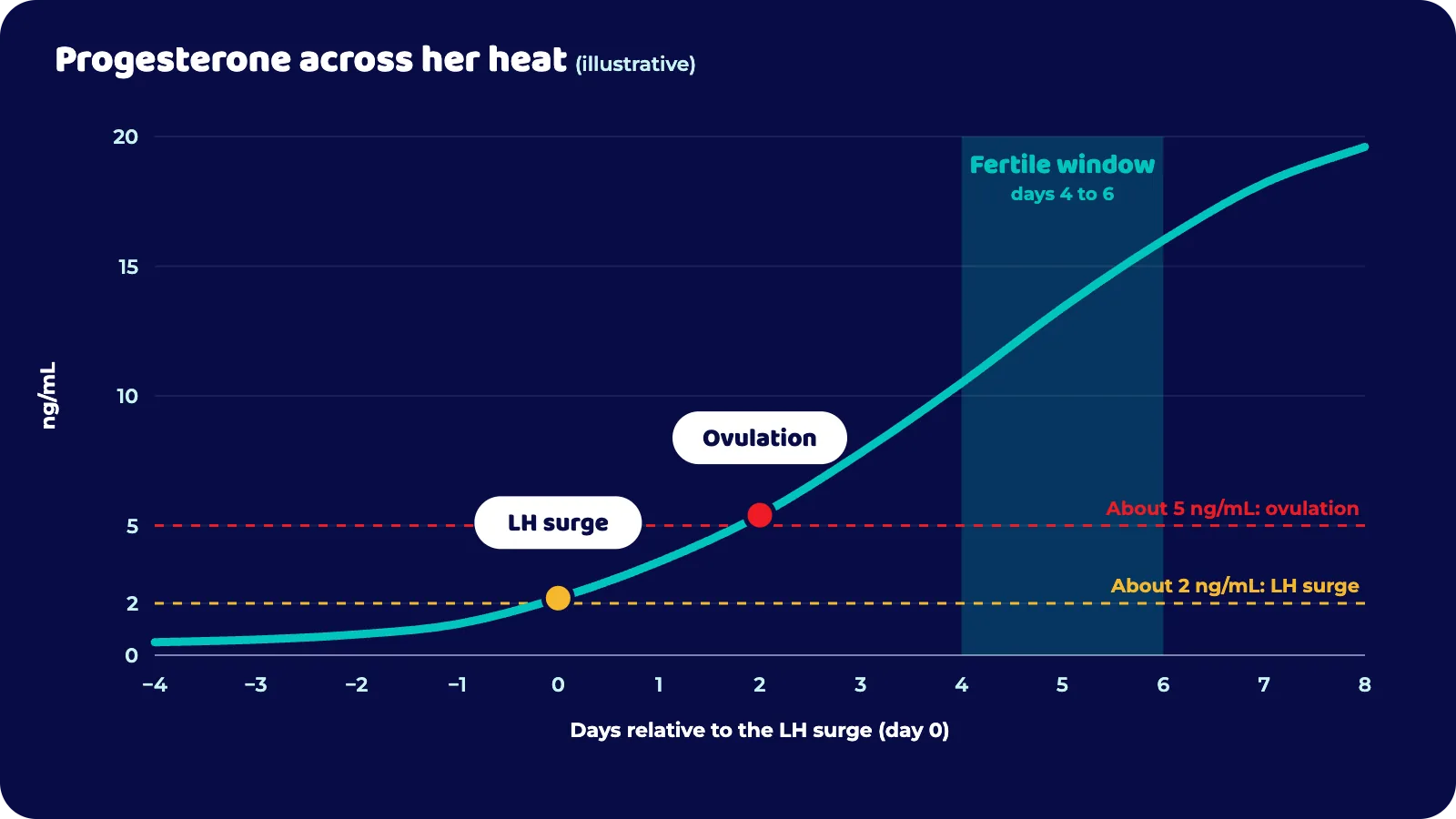
Progesterone milestones and what to do
Milestone | Typical progesterone | Timing | What to do |
|---|---|---|---|
Baseline | Low, under about 1.5 ng/mL | Most of proestrus | Keep testing on your vet's schedule |
LH surge | First rise above about 2 ng/mL | Day 0 | Start counting. Alert the stud owner |
Ovulation | Above about 5 ng/mL | About day 2 | Eggs released, still maturing |
Fertile window | Keeps rising | About days 4 to 6 | Breed or inseminate now |
When to Breed a Dog in Heat: A 5 Step Timing Plan
From first spot of blood to the right breeding day
Knowing when to breed a dog in heat is really a matter of following a sequence. Here is the order that keeps the guesswork low, whether you are working with a local stud or shipping semen across the country. It also answers when to mate a dog in season in practical terms: on the days her tests point to, not the days the calendar suggests.
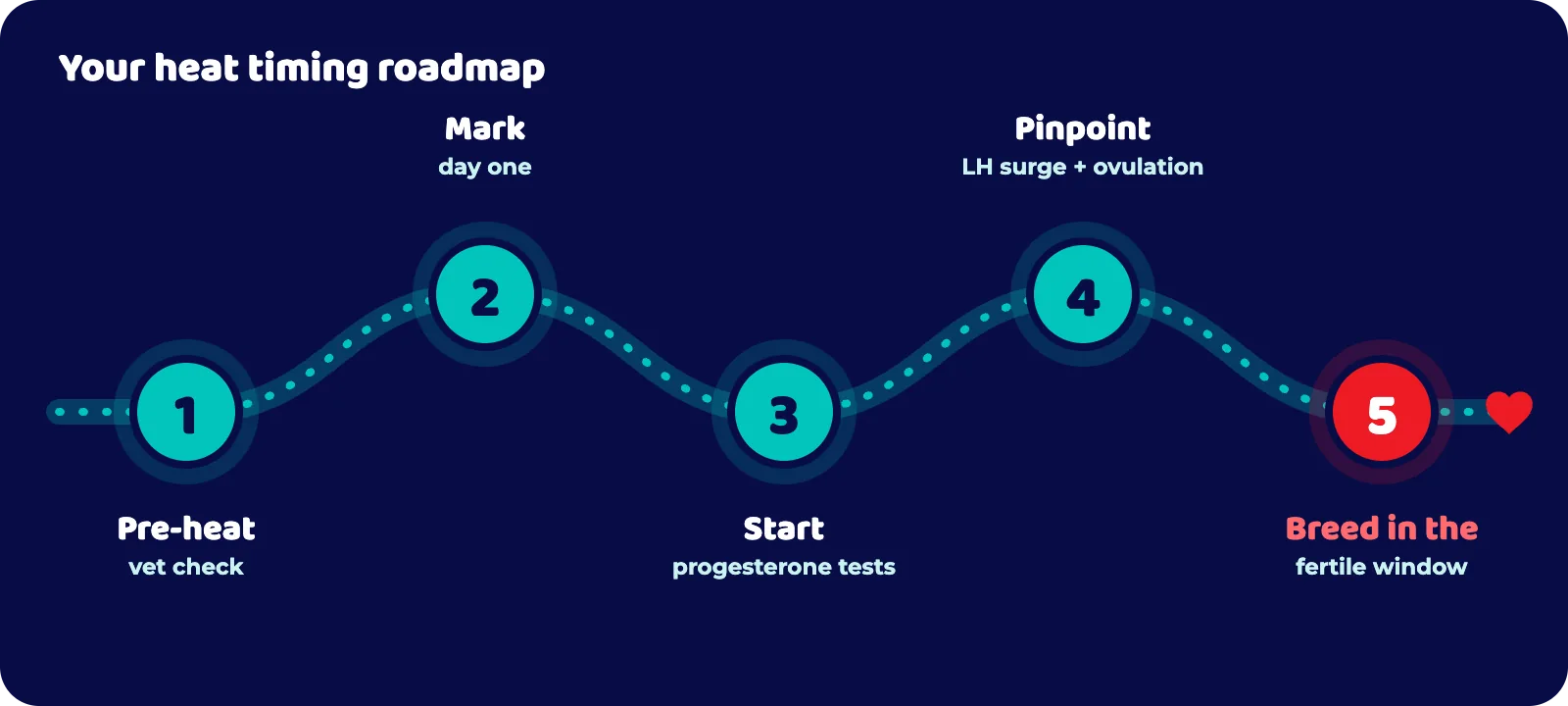
1Book a pre-breeding vet check before she starts
Schedule an exam and a brucellosis test ahead of her heat. The AKC recommends testing every female before each breeding, and most stud owners will ask to see the result. This is also the time to line up a stud. Petsfindly suggests starting your search two to three months before her next heat, and the dog mate finder lets you compare breed, distance and shared health tests.
2Mark day one
Day one is the first day you see swelling or bloody discharge. Tell your vet and the stud owner the same day. Keep her leashed and supervised from now until heat is fully over, since the AKC warns that intact males can track a female's scent and even a fenced yard is not fully safe.
3Start progesterone testing early
Your vet will usually start testing during proestrus and repeat it every day or two as levels approach the surge. Some females have very short heats, and dvm360 notes these may need testing from the very first sign, so do not wait for flagging to begin.
4Pinpoint the LH surge and ovulation
Once progesterone crosses the surge level, your vet can estimate ovulation and give both owners a breeding date. Share results with the stud owner straight away so travel or shipping can be arranged.
5Breed in the fertile window
Plan matings or insemination for the days your vet recommends, usually around 4 to 6 days after the LH surge. Your vet can then confirm pregnancy a few weeks later. Settle the follow-up terms, such as a repeat breeding if she does not conceive, before breeding day. Petsfindly's list of questions to ask a stud dog owner helps you cover them.
Fresh, Chilled or Frozen: How the Window Changes
The shorter sperm survive, the tighter your timing
Natural breeding is the most forgiving option because fresh sperm live for days inside the female. Chilled and frozen semen survive for far less time, so they must arrive almost exactly when her eggs are ready. The figures below come from dvm360's breeding management proceedings.
How semen type affects breeding timing
Method | How long sperm survive | Typical timing | Room for error |
|---|---|---|---|
Natural mating or fresh AI | About 5 to 6 days in the uterus | Across the fertile window, often more than one breeding | Most forgiving |
Fresh chilled AI | About 24 to 72 hours | About 2 to 4 days after ovulation | Moderate. Courier timing matters |
Frozen AI | About 12 hours on average | A single, precise insemination, often around day 5 after the LH surge | Very little. Needs a specialist vet |
If the stud lives across the country, ask early which method the stud owner offers. That choice affects how many progesterone tests you need and how quickly you have to act once the numbers move.
Split Heats, Silent Heats and Breed Differences
When her cycle refuses to follow the textbook
Split heats
The AKC explains that first-time cycles can split. She shows signs, stops, then starts again, usually within a few weeks, because young females may not yet produce enough hormones to ovulate the first time. If her signs fade and return, call your vet before booking anything.
Silent heats
Some females, especially small dogs and older dogs, cycle and ovulate with little visible swelling or discharge. If she seems overdue, ask your vet about testing rather than assuming she skipped a heat.
Breed spotlight: Basenji
Basenjis are the clearest exception to the "no season" rule. They cycle once a year, typically in spring, so a missed window can mean a full year's wait. Start stud conversations well before the season.
Breed spotlight: toy breeds like the Yorkshire Terrier
Small breeds such as the Yorkshire Terrier tend to have their first heat early and may cycle more often. Their signs can also be subtle, so many owners rely on progesterone testing sooner than they would with a larger dog.
Breed spotlight: large breeds like Golden Retrievers and German Shepherds
Larger dogs such as the Golden Retriever and German Shepherd Dog often have their first heat closer to a year or later, and early cycles can be irregular. Giant breeds may not settle into a pattern until about two years old.
Frequently Asked Questions
Quick answers on heat, timing and mating
When can dogs mate for the first time?
Physically, a female can mate at her first heat, which may come as early as 6 months. Responsibly, most breeders wait until she is about two years old and has finished her health screenings, as the AKC recommends.
Can a female dog get pregnant while she is still bleeding?
Yes, it is possible. The shift from proestrus to estrus is gradual, and VCA notes that sperm can survive about a week in her reproductive tract. Keep her supervised from the first sign of heat until it is completely over.
How many days after bleeding starts is she ready to mate?
There is no fixed number. Proestrus averages about nine days but can range from about 3 to 21, so progesterone testing is the only dependable way to find her fertile days.
When is a dog's mating season?
For most breeds, the answer to when is a dog's mating season is that there is no set season. A female can come into heat at any time of year, about every six to seven months. Basenjis and some sled dog breeds are the exception and usually cycle in spring.
How do I know her heat is over?
Her vulva returns to normal size, discharge stops and males lose interest. That marks diestrus, when she is no longer fertile. Your vet can confirm the change with a vaginal smear if timing matters.
Does a tie mean the mating worked?
Not necessarily. A tie is common in natural mating, but VCA notes that pregnancy can happen without one, and a tie does not guarantee puppies. Only your vet can confirm a pregnancy.
The Bottom Line
Read the signs, trust the tests, book early
So, when is a female dog ready to mate? When two clocks line up: she is mature and health tested, and she is in estrus a few days after ovulation. The signs tell you when to pick up the phone. The progesterone tests tell you when to book the stud.
Plan ahead, log every heat, and line up your partner before her next cycle begins. A great match on the wrong day is still a missed litter.
Her next heat is coming
Find a stud before her next heat
Browse phone-verified owners near you, compare breed, distance and shared health tests, and message before her window opens.
- Free to browse
- Phone-verified owners
- We never take payments
Further reading
- American Kennel Club: When do dogs go into heat?
- American Kennel Club: How long are dogs in heat?
- American Kennel Club: Brucellosis testing for breeders
- VCA Animal Hospitals: Estrus cycles in dogs
- University of Missouri VMDL: Progesterone testing
- dvm360: Breeding management, it's all timing
- Merck Veterinary Manual: Reproductive disorders of female dogs
This guide is general information for dog owners and is not veterinary advice. Every female is different, so talk to your veterinarian before making any breeding or health decision.